EN
 FR
 DE
 IT
 PT
 ES


Tips for Selling Surplus Licences

How to sell your company’s surplus software licences. Companies often accumulate software licences after mergers, downsizing, cloud migrations, supplier changes or volume purchases that were larger than the real need. Those licences may look like a sunk cost, but they can still have value if they are perpetual, transferable and properly documented.
Contents
- Why companies end up with surplus licences
- The European legal framework for used software
- Which licences usually keep value
- Documents to prepare before selling
- How surplus licences are valued
- Recommended resale workflow
- Mistakes that block a sale
- What companies buy after selling surplus stock
Why companies end up with surplus licences
Companies often accumulate software licences after mergers, downsizing, cloud migrations, supplier changes or volume purchases that were larger than the real need. Those licences may look like a sunk cost, but they can still have value if they are perpetual, transferable and properly documented.
The opportunity is to turn an idle asset into cash without weakening compliance. Doing that well is not the same as selling a list of keys. A professional transaction proves origin, usage rights, internal deinstallation and a clean transfer trail.
The European legal framework for used software
In the European Union, resale of certain used software is connected to exhaustion of the distribution right. The central reference is the Court of Justice ruling in UsedSoft v Oracle, together with Directive 2009/24/EC on the legal protection of computer programs.
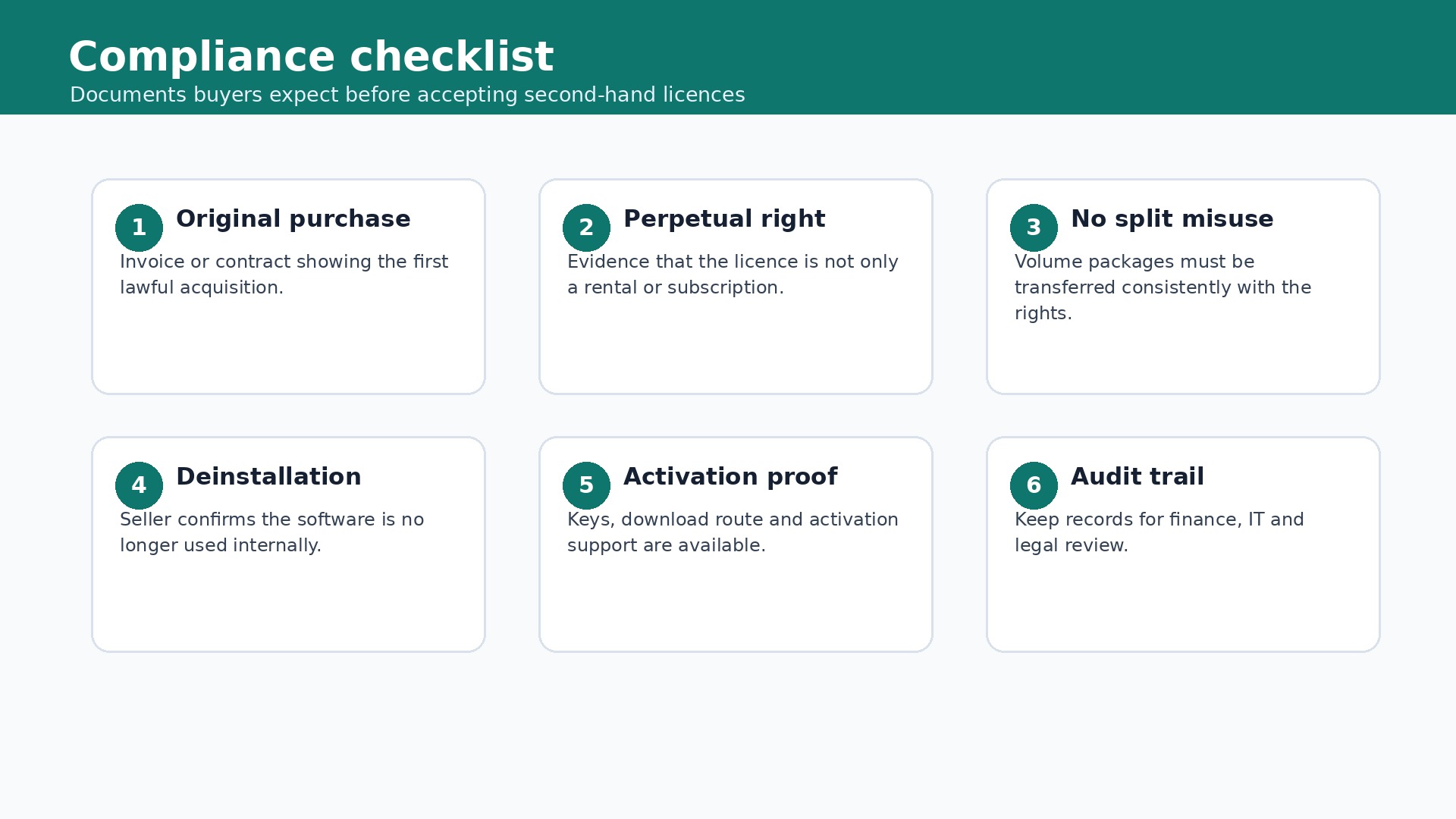
In practice, the buyer wants evidence that the licence was lawfully acquired, that the right is perpetual or economically equivalent to a sale, that the seller stops using it, and that a package is not split in a way that conflicts with its terms. Not every licence can be resold, but many perpetual licences deserve a structured review.
Which licences usually keep value
Microsoft Office, Windows Server, SQL Server, Project, Visio, CAD tools, statistical software and professional suites often retain demand when the version is stable and still useful. Buyers value known editions, clear activation, complete paperwork and products that solve everyday business needs.
Pure subscriptions, education licences, promotional keys, OEM licences tied to hardware and rights limited by contract are more difficult. Before selling, classify each licence by product, edition, language, seats, contract type, purchase date and activation status.
Documents to prepare before selling
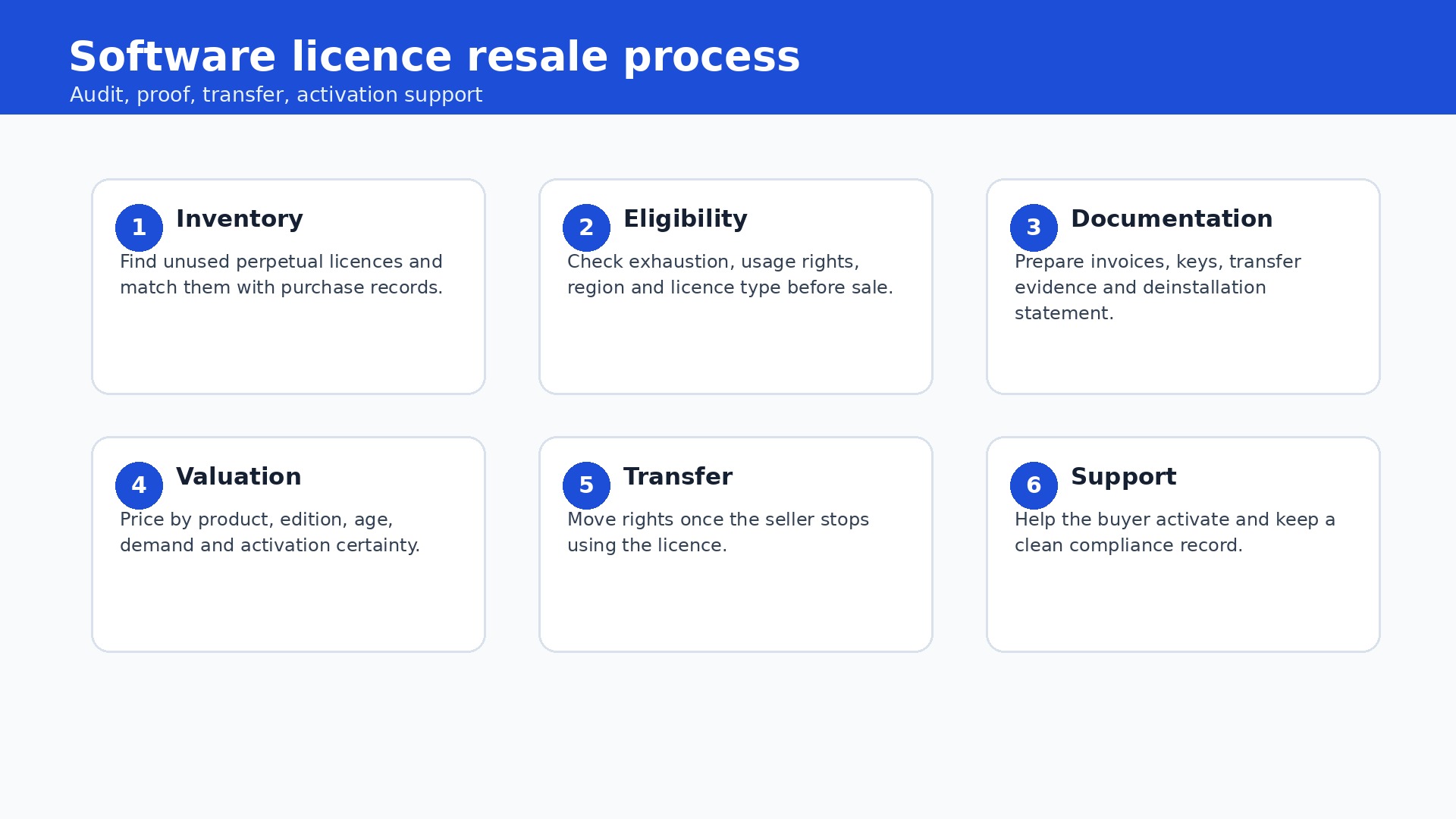
Documentation drives the deal. A serious buyer will ask for the original invoice, contract or licence certificate, payment evidence, number of licences, product identifiers, ownership history and a deinstallation or non-use declaration. For larger corporate purchases, a complete chain of transfer may also be requested.
The clearer the file, the stronger the valuation. If the company only has keys without invoices, risk rises and price falls. If invoices, volume agreements and internal retirement evidence are available, the transaction becomes easier for procurement, finance and audit teams to accept.
How surplus licences are valued
Valuation combines demand, age, edition, compatibility, seat count, document quality and activation risk. A popular licence with full evidence can be worth far more than a rare edition with weak records, even if both look similar in an inventory spreadsheet.
The sales channel also matters. Direct sale can increase the price, but it requires legal review, buyer qualification and support. A specialised buyer reduces friction and helps filter licences that should not be moved. For finance teams, fast and reliable payment may matter as much as the theoretical highest price.
Recommended resale workflow
Start with a full inventory. Separate active licences, inactive licences, subscriptions, OEM rights and perpetual licences. Collect proof, confirm that the software is no longer used, remove internal installations where required and define who signs the transfer statement.
Then request valuation, review terms, agree price, transfer documentation and deliver keys or access details as appropriate. Keep a complete file: request, valuation, contract, invoice, deinstallation statement and delivery confirmation. That archive is what protects the company in a later audit question.
Mistakes that block a sale
The most common mistake is sending a mixed and incomplete list. Another is trying to sell licences that are still installed, keys with unclear origin, or volume packages split without checking terms. That slows valuation and may cause professional buyers to reject the deal.
Avoid absolute promises as well. Legal resale depends on licence type and evidence. A careful, proof-based message creates more confidence than claiming that every unused licence can be sold.
What companies buy after selling surplus stock
Many companies sell older licences because they are migrating or standardising their software estate. In that situation, buying reviewed Microsoft Office licences can still make sense for workstations that do not need a monthly subscription. Licendi offers competitively priced Office licences for businesses that want cost control.
If the goal is to buy for new devices, check compatibility, users and activation policy first. If the goal is to sell surplus rights, prepare the inventory with the same discipline as an internal audit. In both cases, clean documentation prevents problems.
Internal checklist before contacting a buyer
Before asking for an offer, prepare a table with product, edition, version, language, licence count, purchase date, original supplier, invoice, contract, installation status and internal owner. Add a risk column to separate licences that are ready, licences needing legal review and licences that should not be sold. This table prevents later confusion and helps procurement, finance and audit teams respond quickly.
Also check whether the licence is linked to an account, specific hardware, maintenance agreement or volume portal. If an administration portal exists, keep internal screenshots for the file, but share only what the buyer genuinely needs. The practical rule is simple: enough evidence to sell, minimal exposure of sensitive data.
Appoint one IT owner and one finance owner for the release of the asset. IT confirms that the software is no longer used; finance confirms that the asset can be sold and invoiced; legal reviews contractual doubts. When these three functions agree, the transaction moves faster and carries less risk.
How to negotiate without losing traceability
Negotiation should not focus only on price. Ask what documents the buyer needs, how the licence will be validated, when payment is made, what support is expected after transfer and what happens if a key needs assisted activation. A professional buyer will have a clear workflow and will not pressure you to skip checks.
Avoid handing over full keys before terms are closed. You can share partial information, redacted screenshots or non-sensitive lists while eligibility is reviewed. Complete delivery should happen only once there is agreement, invoice or contract and a defined payment route. That protects the company and keeps control over the asset.
Document every scope change. If the first list contains 80 licences and 12 are later removed because of doubts, record it. If an edition is corrected or a key excluded, update the inventory. Traceability is not only for audits; it also prevents commercial misunderstandings.
When not to sell
Do not sell licences if origin cannot be proved, if they are still installed, if they belong to a non-transferable active subscription, if they are tied to OEM hardware, if they are part of a contract with clear restrictions or if the original supplier requires conditions you cannot satisfy. Forcing a doubtful sale usually costs more than writing off the asset.
It may also be better not to sell when the business could need the licences soon. If a migration is still in progress, wait until the new environment is stable. Keeping a small buffer of licences for a few weeks can prevent urgent repurchases, interruptions or activation issues on critical workstations.
The final decision should balance price, risk and effort. A low-value licence with weak documents can consume hours of review without paying back. A well-documented lot of Office, Visio, Project or server licences, however, can justify a formal process and recover a meaningful part of the original investment.
Responsibilities by department
IT should validate installations, users, keys, portals and technical retirement. Finance should confirm book value, sales invoice, tax treatment and evidence retention. Legal should review contractual limits, ownership chain and wording of the transfer declaration. Procurement can compare offers and require clear payment terms.
When each function knows what to check, the transaction stops depending on improvised email threads. A small approval workflow with dates, owners and evidence reduces the risk of selling the wrong asset or forgetting valuable licences. In companies that face regular audits, this internal control can be almost as valuable as the sale proceeds.
After closing, update the master inventory. Mark licences as transferred, store the file and tell support teams that those keys must not be reinstalled. If the internal system is not updated, someone may try to reuse a sold licence months later and create an avoidable compliance issue.
Audit file model
A complete file should include an internal cover note with date, owner, reason for sale and summary of the lot. Then add the detailed inventory, purchase invoices, contracts, payment evidence, deinstallation evidence, valuation received, internal approval, sales invoice and delivery confirmation to the buyer.
The file does not need to be complex, but it must be orderly. Use consistent file names, keep final versions as PDF and store a copy in the company document repository. If someone asks in two years why those licences are no longer available, the answer should be found in minutes.
It is also useful to record rejected licences. If a licence was not sold because the invoice was missing, because it was OEM restricted or because the contract was unclear, write down the reason. That record prevents another team from repeating the review later and shows that the company acted carefully.
Finally, turn the lesson into an internal policy. Every future purchase should store invoices, conditions, seat count and owner from day one. The best sale of surplus licences starts much earlier: it starts with a well-documented purchase.
One final practical point: always separate sale, purchase and support roles. The person negotiating price should not be the only person validating technical eligibility. This separation creates internal control, reduces errors and shows that the company treated licences as assets with rights and obligations, not as simple keys.
If the lot contains several products, prioritise the licences with higher value and stronger documentation. Start with Office, Project, Visio, server products or professional tools with clear invoices. Leave old, incomplete or low-demand licences for later. That produces early results without blocking the whole project on difficult cases.
For small businesses, the benefit is not only cash recovery. The process cleans the inventory, reduces audit noise, avoids unnecessary maintenance costs and improves software purchasing discipline. A well-executed sale leaves the software estate more organised than before.
For legal context, review the EU Software Directive and the CJEU UsedSoft ruling.
Directive 2009/24/EC · CJEU C-128/11 UsedSoft
View Microsoft Office licences at Licendi. Microsoft Office 2021 Professional Plus.
Frequently asked questions
Is it legal to sell used software licences?
It can be legal in the EU when requirements such as lawful acquisition, perpetual rights, exhaustion, seller non-use and sufficient evidence are met.
Can I sell Microsoft 365 licences?
Microsoft 365 subscriptions are generally not sold as used perpetual licences. The exact contract terms must be reviewed.
What documents do I need?
Original invoice, contract or certificate, payment evidence, number of licences, deinstallation statement and ownership trail.
How much are my surplus licences worth?
Value depends on product, edition, demand, age, seats, activation certainty and document quality.