EN
EN FR
FR  DE
DE  IT
IT  PT
PT  ES
ES 

Windows Server 2025 Essentials: Smart Power for SMEs
Introduction: The Digital Challenge for SMEs
In today’s competitive business landscape, Small and Medium-sized Enterprises (SMEs) face a constant challenge: the need to digitize in order to operate efficiently, manage their data securely, and stay ahead of the curve. However, this digital transformation often clashes with budget constraints and a lack of specialized IT personnel. Finding the right technological tool—one that is powerful yet affordable and easy to manage—is crucial.
This is where the new generation of Microsoft’s server operating system comes into play: Windows Server 2025. Built on key pillars such as advanced multilayer security, seamless hybrid cloud integration, and optimized performance ready for future demands like Artificial Intelligence (AI) and Machine Learning (ML), Windows Server 2025 represents a significant leap forward.
Within this family, there is an edition specifically designed for the unique needs of small businesses: Windows Server 2025 Essentials. It is not simply a more affordable option, but a strategically designed solution from the ground up to offer the core functionalities an SME needs, without the complexity or cost of higher editions. This edition positions itself as the smart gateway to the world of modern servers for businesses with limited resources.
In this article, we will explore in depth what Windows Server 2025 Essentials is, its key features, the concrete advantages it offers to SMEs, its inherent limitations, who it’s ideal for, and of course, how to acquire it safely and legally. Join us as we discover whether this is the missing piece in your business’s technological puzzle.
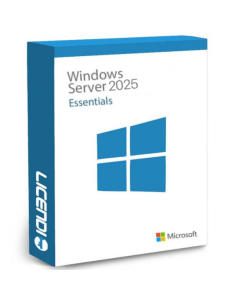
What is Windows Server 2025 Essentials?
Windows Server 2025 Essentials is a specific edition of the Windows Server 2025 operating system, whose main purpose is to provide fundamental server functionalities for small business environments. Think of it as the central nervous system of your small network: a place to manage users, securely store and share files, control printers, and run basic business applications.
Its target audience is clearly defined: small businesses with a strict maximum of 25 users AND 50 devices. It is vital to understand that these are not recommended numbers, but technical limits imposed by the license. Exceeding these thresholds would require upgrading to a higher edition like Standard.
The defining features of Essentials lie in its licensing and hardware limitations, designed to maintain simplicity and affordability:
- Per Physical Server License: Essentials is licensed for a single physical server.
- CPU Limitation: It only supports servers with a single CPU socket.
- Core Limit: The license covers a maximum of 10 CPU cores within that single socket.
- RAM Limit: Supports up to 64 GB of RAM.
- Restricted Virtualization Rights: It allows running a single instance of the operating system (OSE), which can be either physical (installed directly on hardware) OR virtual (as a virtual machine). It’s important to understand that this does not allow running multiple Windows Server licensed VMs on the same host, unlike the Standard edition.
- No Client Access Licenses (CALs) Required: One of its major advantages is that it does not require the purchase of additional CALs for users or devices accessing the server, within the 25/50 limits.
An important aspect to consider is how Essentials is acquired. It is generally distributed through OEM (Original Equipment Manufacturer) channels, meaning it comes pre-installed on new servers from manufacturers like HPE, Dell, etc., or through ROK (Reseller Option Kit), which are kits sold by these same manufacturers through their authorized distributors for installation on compatible hardware.
It’s worth noting that, although licensed in a more restrictive way, the technological base of Windows Server 2025 Essentials is fundamentally the same as the Standard edition. This is not a "cut-down" product in terms of core functionality or security—it’s simply that scalability and certain advanced features are limited by licensing terms. This has an important implication: if an SME grows and exceeds the Essentials limits, transitioning to the Standard edition mainly involves a license change and acquiring CALs, not migrating to a radically different technology platform.
The reliance on OEM/ROK channels also means that SMEs typically cannot purchase an Essentials license directly from Microsoft. They need to acquire it along with new hardware or through specialized resellers. This highlights the importance of working with trusted technology partners when purchasing, a point we will revisit later.
Key Innovations in Windows Server 2025 for Essentials
As an integral part of the Windows Server 2025 family, the Essentials edition directly benefits from many of the improvements and innovations introduced across the platform. Even small businesses can leverage these advancements to strengthen their infrastructure:
Enhanced Security
Security is a top priority in Windows Server 2025, and Essentials inherits these critical enhancements:
- Secured-core Server Principles: While it depends on compatible hardware (with TPM 2.0 and Secure Boot), Windows Server 2025 extends "secured-core" principles to protect against firmware and boot-level threats.
- Improvements in Active Directory (AD): Even in a single-server environment acting as a domain controller (a common role for Essentials), it benefits from more secure default configurations, such as LDAP encryption by default, stronger cryptography in Kerberos, and randomly generated machine account passwords.
- SMB Protocol Hardening: The file-sharing protocol (SMB) receives significant upgrades. SMB over QUIC is now available across all editions, offering a more secure, encrypted, and low-latency connection for remote file access over the internet. Additionally, an SMB authentication rate limiter has been introduced to help prevent brute-force attacks.
- Credential Guard by Default: This virtualization-based security (VBS) feature, if supported by hardware, isolates and protects user credentials (such as passwords and hashes) to make them harder to steal—even if the OS kernel is compromised.
The inclusion of these robust security features in the entry-level edition is fundamental. SMEs are increasingly frequent targets of cyberattacks and often assume that "basic" editions are less secure. Windows Server 2025 Essentials challenges this perception by offering a significantly stronger security foundation than previous server OS versions—democratizing access to enterprise-level protections.
Improved Experience and Usability
Microsoft has worked to make Windows Server 2025 easier to use and manage:
- Updated User Interface: The desktop experience adopts the visual style of Windows 11, which may feel more familiar and comfortable for admins or users who also work with the client OS.
- Simplified Connectivity: A standout feature is native support for Wi-Fi and Bluetooth. While the respective services must be enabled manually, having the components pre-installed greatly simplifies wireless server connections. This can be especially useful for SMEs installing servers in non-traditional locations (like a back office) where network cabling may be inconvenient.
- Integrated Modern Tools: The inclusion of Windows Terminal (a modern and powerful command-line application) and the WinGet package manager (for installing and managing apps from the command line) streamlines administrative tasks.
- Native File Compression: The OS now includes built-in support for compressing and extracting popular formats like ZIP, 7z, and TAR directly from the File Explorer.
These usability improvements are not merely cosmetic. They reduce the learning curve and simplify daily management—especially valuable for businesses with little or no dedicated IT staff.
Ready for a Hybrid Future
Windows Server 2025 makes it easier to connect on-premises environments with Microsoft Azure:
- Improved Integration with Azure Arc: Connecting a Windows Server 2025 instance to Azure Arc is now easier. Azure Arc enables managing on-prem servers as if they were Azure resources. For an SME using Essentials, this opens the door to benefits like:
- Centralized Inventory: View and organize the server alongside other resources in the Azure portal (via Azure Resource Graph).
- Simplified Update Management: Use Azure Update Manager to manage server updates.
- Enhanced Security Monitoring: Integration with Microsoft Defender for Cloud for a more comprehensive security posture.
- Hotpatching: One of the most tangible advantages is the ability to apply certain critical security updates without needing to restart the server, significantly reducing downtime. This feature requires the server to be connected and managed via Azure Arc.
Azure Arc integration positions Windows Server 2025 Essentials not as a purely local and isolated solution, but as a potential first step into a managed hybrid environment. For an SME, this provides future flexibility and access to advanced services like Hotpatching, which minimizes business disruption—a critical factor when every minute of downtime counts.
Key Advantages of Essentials for Your Business
Beyond the platform innovations, the Essentials edition offers specific advantages that make it very appealing for SMEs:
Cost-Effectiveness (No CALs Required)
Perhaps the most significant financial benefit of Essentials is its simplified licensing model. Standard and Datacenter editions of Windows Server require the purchase of Client Access Licenses (CALs) for each user or device accessing the server. These CALs can represent a considerable additional cost, especially as the number of users grows.
Windows Server 2025 Essentials completely removes the need for CALs for its allowed 25 users and 50 devices. This drastically simplifies licensing and lowers the Total Cost of Ownership (TCO). To put it into perspective: acquiring 25 user CALs for a Standard edition could easily add hundreds, if not over a thousand dollars/euros, to the server license’s initial cost. For a budget-conscious SME, this savings can be a decisive factor.
Simplicity in Deployment and Management
Essentials is designed with environments that have limited IT resources in mind. Its initial setup is usually simpler, and management tools—such as possible integration with Windows Admin Center (WAC)—are focused on streamlining basic administrative tasks. By focusing on essential functionality, overall complexity is reduced compared to higher-tier editions.
Essential Functionality
Despite its simplicity-focused approach, Essentials provides the fundamental tools that a small business needs:
- Reliable file and printer sharing: Enables centralization of company data and efficient management of shared printer access.
- Basic identity management: Can function as the sole domain controller (DC) for a small Active Directory domain, centralizing user authentication and applying basic policies. It's important to note Essentials' specific limitations in this role: it must be the forest root DC, cannot be a secondary domain, and cannot have trust relationships with other domains.
- Foundation for centralized storage and backups: Provides a central location for data, making it easier to implement backup strategies using tools like Windows Server Backup or cloud services like Azure Backup (via Azure Arc integration).
Modern Security for SMEs
As mentioned earlier, Essentials inherits the security enhancements of the WS2025 platform. This means SMEs gain access to modern security concepts and robust protections (such as SMB over QUIC, Credential Guard, and AD improvements) in an affordable package—helping safeguard their most valuable asset: their data.
Addressing the Limitations
It’s crucial to be transparent about Essentials' limitations: the caps of 25 users/50 devices, 10 cores, 64 GB of RAM, and especially the virtualization restriction to a single OSE. The key question every SME must ask is: Does my business need more than this now or in the foreseeable future? Do I have virtualization requirements that involve running multiple Windows Server instances on a single physical host?
For many small businesses that only need a reliable server for core tasks such as file sharing, basic user management, and perhaps running a specific business application, these limits are perfectly acceptable. The trade-off of cost savings and simplicity far outweighs the restrictions. However, the virtualization limitation is a clear threshold: if there’s a foreseeable need to run even two virtual machines with Windows Server (e.g., a domain controller and a separate application server), Essentials is not the right fit, and the Standard edition should be considered.
Typical Use Cases for Essentials
The combination of simplicity, cost, and core functionality makes Essentials ideal for specific SME scenarios:
- The Company’s First Server: Perfect for businesses making the jump from a simple peer-to-peer network or exclusive cloud storage use, seeking a centralized, managed on-premises solution for their data and users.
- Central File and Print Server: Its most common role is to act as a central, secure repository for company documents, managing access permissions and office printer sharing.
- Basic Domain Controller: To establish a simple Active Directory domain, enabling centralized logins across network computers and applying basic group policies (while respecting Essentials’ limitations as the sole root DC of the forest).
- Hosting Lightweight Applications: Suitable for running line-of-business (LOB) applications that are not resource-intensive and don’t require multiple server instances. Examples could include an accounting software database, an industry-specific tool, or a small intranet.
- Small Offices or Branch Locations: Can meet the basic needs of a small branch, as long as the number of users and devices stays within the licensing limits.
In all these cases, Essentials’ inherent simplicity becomes a valuable feature. An SME setting up its first server does not need or want the complexity of Datacenter-level features like software-defined networking (SDN) or Storage Spaces Direct. What it needs is a reliable, easy-to-manage foundation for daily operations—and Essentials is designed exactly for that.
Key Comparison: Essentials vs. Alternatives
Making the right decision requires comparing Essentials with its direct alternatives.
Essentials 2025 vs. Standard 2025
This is the most important comparison for an SME considering Windows Server 2025. The following table summarizes the key differences:
| Feature | Windows Server 2025 Essentials | Windows Server 2025 Standard |
| Target Audience | Very small businesses (<25 users) | Growing SMEs / Mid-size companies |
| User/Device Limit | 25 users / 50 devices (max) | Unlimited (with CALs) |
| Server Licensing | 1 server, 1 socket, max. 10 cores | Core-based (min. 16 cores/server), multi-socket |
| CAL Requirement | No | Yes (User or Device) |
| Virtualization Rights | 1 OSE (physical or virtual) | 2 OSEs/VMs + Host (per Standard license) |
| Advanced Features¹ | No | Limited (e.g., Storage Replica 2TB) |
| RAM/CPU Capacity² | 64GB / 10-core / 1-socket (license cap) | 4PB / 64-socket (platform limits) |
| Relative Cost | Low | Medium (consider CAL costs) |
¹ Features like Storage Spaces Direct or Shielded VMs are exclusive to Datacenter.
² RAM/CPU limits for Standard/Datacenter reflect platform max capacity; Essentials is limited by its license.
This table distills the critical differences in an easy-to-understand format, helping SMEs identify which edition best fits their scale, virtualization needs, and budget.
Essentials 2025 vs. Previous Versions
For businesses already using a previous version of Essentials, upgrading to 2025 primarily offers benefits from the underlying platform:
- Enhanced Security: Access to the latest WS2025 protections and security features.
- Potential Performance: Possible performance and efficiency gains from OS optimizations.
- Modern Experience: Updated user interface and modern management tools.
- Better Hybrid Integration: Smoother Azure Arc capabilities and the option for Hotpatching.
- Direct Upgrade Path: In-place upgrades are possible from versions as old as Windows Server 2012 R2.
It’s important to highlight that the core limitations of Essentials (users, devices, cores, sockets, OSE, no CALs) remain consistent across recent versions. Therefore, the main reason to upgrade from Essentials 2019 or 2022 to 2025 is to gain a more secure, modern, and potentially more efficient platform—not to overcome the inherent constraints of the Essentials edition. If a business has outgrown those limits, the appropriate upgrade path is to the Standard edition.
System Requirements for Essentials
Before purchasing the license, it’s essential to ensure that your server hardware (existing or planned) meets the minimum requirements to run Windows Server 2025. Although Essentials has specific licensing limits (10 cores, 64GB RAM), the base operating system requirements are those of the WS2025 platform:
| Component | Minimum Requirement | Recommended Requirement |
| Processor (CPU) | 1.4 GHz 64-bit, x64-compatible, support for NX/DEP, CMPXCHG16b, LAHF/SAHF, PrefetchW, EPT/NPT, SSE4.2, POPCNT | 2.0 GHz or higher 64-bit |
| Memory (RAM) | 2 GB (for Desktop Experience) | 4 GB or 8 GB+ |
| Disk Space | 32 GB free for system partition¹ | 60 GB free or more |
| Network Adapter | Gigabit Ethernet (1 Gbps) | Gigabit Ethernet |
| Firmware | UEFI 2.3.1c-based system with Secure Boot (for certain features) | UEFI with Secure Boot |
| Security | Trusted Platform Module (TPM) 2.0 (for features like BitLocker) | TPM 2.0 |
| Graphics/Monitor | Super VGA (1024x768) or higher device and monitor (for certain features) | SVGA (1024x768) or higher |
| Other | Keyboard, Mouse (or compatible), Internet access (may incur fees) | Keyboard, Mouse, Internet access |
¹ 32 GB is the absolute minimum. More space is required if installing over the network or if the server has more than 16 GB of RAM (for paging, hibernation, and dump files). Installing with Desktop Experience requires ~4 GB more than Server Core.
This table acts as a quick checklist. It's crucial to remember that while the OS may install on hardware that exceeds the Essentials license limits (e.g., a 12-core processor), such usage would not comply with the license terms. The Essentials license limits usage to 10 cores, 1 socket, and 64GB of RAM.
Licensing and Acquisition of Essentials
Let’s recap the golden rules of Essentials licensing, which make it so attractive to small businesses:
- One license per physical server is required.
- This license covers a maximum of 10 processor cores in a single CPU socket.
- It grants the right to run one instance of the OS, either on physical hardware or as a virtual machine.
- No CALs required for users or devices, up to the limit of 25 users and 50 devices.
As mentioned, the most common acquisition path is through OEM or ROK. This model ensures the license is used in its intended context: a single server, often newly purchased, for a small business. When planning the purchase, make sure to look for this edition when buying hardware or contact specialized distributors offering ROK kits.
Since acquisition usually occurs through specific channels, it’s important to rely on trusted distributors that offer genuine licenses and proper support for SMBs. Finding a reliable provider that understands small business needs and provides legitimate licenses is essential.
A great option for securely and legally purchasing your Windows Server 2025 Essentials license with expert support is through Licendi. They specialize in software licensing and understand the nuances of editions like Essentials.
Conclusion: Is Essentials Right for Your Small Business?
Windows Server 2025 Essentials is defined as a modern, secure, and highly cost-effective server solution, specifically designed for the needs and constraints of small businesses. Its key features are clear: a limit of 25 users and 50 devices, support for up to 10 cores in a single socket, rights for one instance of the OS (physical or virtual), and most importantly, no CALs required.
For small businesses, the advantages are obvious:
- Affordability: Eliminating CALs significantly reduces total cost.
- Simplicity: Less complexity in licensing and management.
- Core Functionality: Covers basic server needs (file, print, basic identity).
- Modern Security: Access to the robust security improvements of Windows Server 2025.
The decision to opt for Essentials should be based on an honest assessment of your business’s current and future needs. If your company operates comfortably within the user, device, and hardware limits, and your virtualization needs are limited to one instance of Windows Server (or none), then Windows Server 2025 Essentials is very likely an excellent and economically smart choice. It provides a solid and secure technology foundation without overburdening your budget or management.