EN
EN FR
FR  DE
DE  IT
IT  PT
PT  ES
ES 

Which Software is Most Worth Buying with a Perpetual License?
Introduction
In Spain, many companies face an important decision when acquiring digital tools: Should they buy software with a perpetual license or subscribe to a recurring payment service? In recent years, the software industry has moved towards the subscription model (known as "Software as a Service" or SaaS), where monthly or annual fees are paid to use applications. However, the traditional perpetual license model—paying a one-time fee for indefinite use of the software—still offers significant advantages worth analyzing. Indeed, as the accumulated cost of multiple subscriptions increases, many organizations are reconsidering returning to permanent licenses to reduce expenses and simplify the management of their IT tools.
The key question is which software is most worth acquiring with a perpetual license, especially with businesses and professionals in mind.
Subscription Licenses vs. Perpetual Licenses: What's the Difference?
Before deciding which software is worth buying with a perpetual license, it's useful to understand the difference between today's two main software licensing models: subscription vs. perpetual. With a subscription license, the company or user pays for the right to use the software for a specific period (for example, monthly or yearly). This model resembles renting: as long as payments continue, you have access to the latest version of the program, continuous updates, and associated services (like cloud storage, support, etc.). However, once you stop paying, you typically lose access to the software completely. This approach requires ongoing spending and continuous management of renewals and active users.
On the other hand, with a perpetual license, the software is acquired through a one-time payment, granting indefinite usage rights for that specific version of the product. In other words, the company permanently owns the license. This means you can use the software for as many years as you wish without incurring mandatory additional payments. In some cases, the vendor may optionally offer maintenance contracts or major updates for an extra fee (for example, an annual support or upgrade fee of approximately 15-20% of the original price), but these are voluntary: the purchased version continues to function even if no further services are acquired. In short, the perpetual model equates to "buying the software" instead of "renting it." While the initial investment is usually higher than short-term subscriptions, there are no additional periodic fees in the long run.
Practical Example
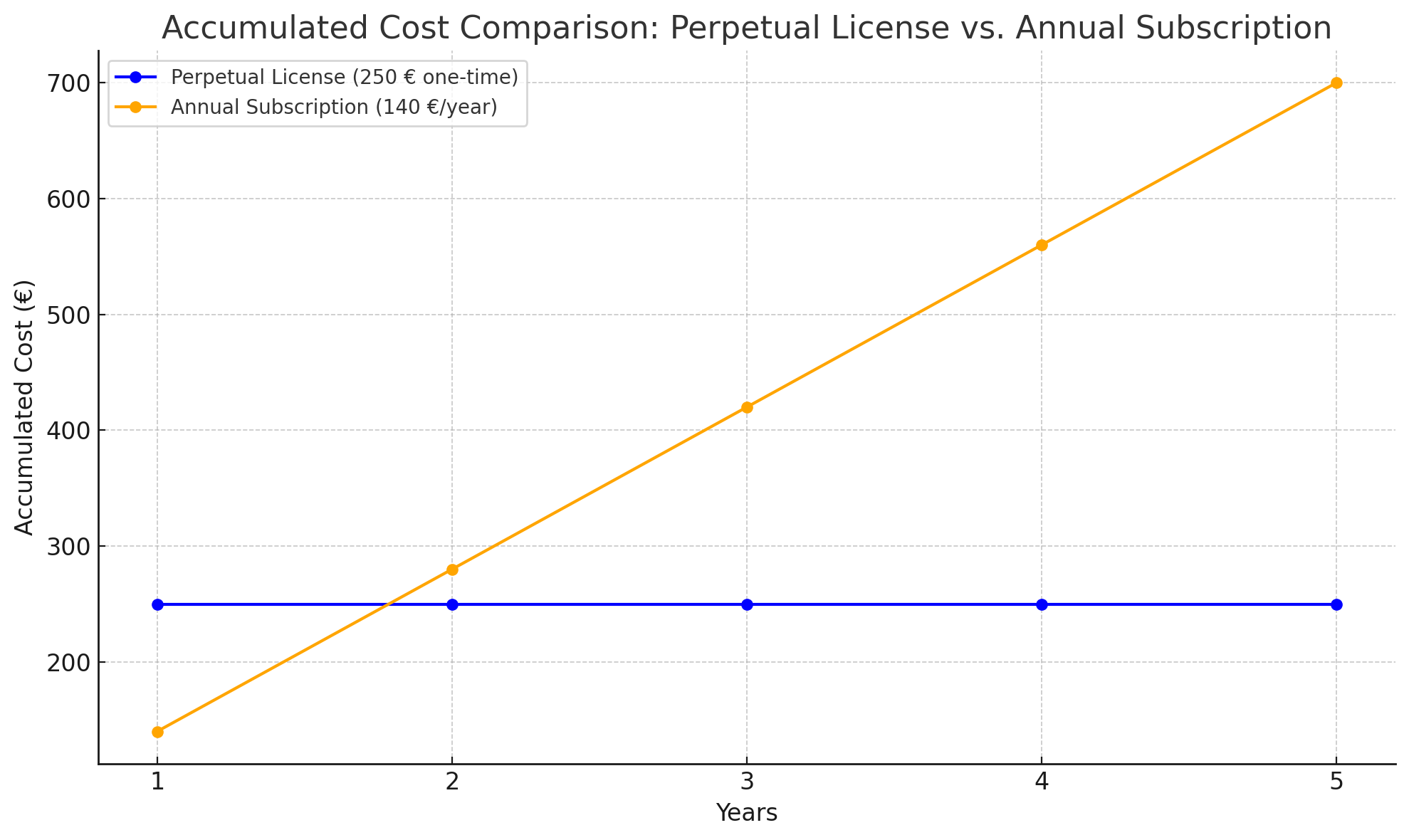
To visualize this difference, imagine software that costs €140 per year per user with a subscription, while the perpetual license for the same software costs a one-time fee of €250. Initially, the subscription seems more affordable (€140 vs. €250 in the first year). But from the second year onward, the cumulative subscription expense (€280) surpasses the one-time outlay of the perpetual license. Each additional year further increases this cost gap. Thus, over several years, the perpetual option can become significantly more cost-effective:
Figure: Accumulated cost comparison between a one-time perpetual license (blue line) and an annual subscription (orange line) over 5 years. In this simplified example, the perpetual license costs €250 once, while the subscription is €140 per user per year. Starting from the second year of use, the total cost of the subscription already surpasses that of the perpetual license, illustrating the long-term potential savings of a permanent license.
In addition to cost savings, another significant contrast is ownership and control. With a perpetual license, the company owns the usage rights and does not depend on the vendor's continuity to keep operating the acquired version. Conversely, under a subscription model, the vendor maintains greater control: they can alter prices, terms, or even discontinue the service, forcing the customer to adapt or migrate. This differentiation directly impacts user management and license administration within organizations.
Benefits of Perpetual Licenses for Businesses
For many organizations, especially SMEs and companies in Spain careful with their budgets, perpetual licenses offer a series of key benefits in terms of cost, control, and management. Below, we outline the most significant advantages of choosing perpetual licenses for business software:
Lower Long-Term Costs and Predictable Budgets
Although perpetual licenses require a higher initial investment, they often prove more economical in the long term due to the absence of recurring payments. The total expenditure over several years can be substantially lower than with subscriptions, enabling more stable budgetary control. Additionally, the company can account for the license as an investment (intangible asset) and amortize its cost over several fiscal years, avoiding surprises from fee increases or renewals.
Ownership of the Software
The organization owns indefinite usage rights.
This provides security: there is no risk of losing access to the tool due to forgetting a renewal or changes in provider policies. Even if the manufacturer stops offering the product or changes their business model, the company maintains the acquired version running on its systems.
Unrestricted and Uninterrupted Usage
With perpetual licenses, you can use the installed version without any time limitations. There are no expiration dates that could interrupt work. Additionally, perpetual software generally continues functioning offline after activation, which is beneficial for high-security environments or places with inconsistent network access. You won't experience application "blackouts" due to subscription expiration or license server downtime.
Flexibility in Updates
Owning the license, the company decides if and when to update to a new version. There is no obligation to accept continuous changes. Some companies prefer maintaining a stable version for years to ensure compatibility with their processes. With perpetual licenses, you can control the pace of updates, applying security patches and improvements as desired, instead of being forced to upgrade to the latest version periodically. This also prevents surprises from interface or functionality changes imposed by the vendor.
Data Control and Privacy
Many subscription-based solutions are cloud services where company data passes through vendor servers. In contrast, software with perpetual licenses typically can be installed locally, allowing companies to keep data within their own infrastructure. This can enhance security and regulatory compliance (such as GDPR data protection) by not relying on third parties to store sensitive information.
Vendor Independence
Once the software is acquired, the organization does not depend on continuous connectivity with the vendor to continue using it. This prevents situations of vendor lock-in, where switching platforms could become complicated or expensive. With perpetual licenses, if the vendor raises support prices or changes terms, there is always the option to keep using the current version at no extra cost, as there is permanent control over the installed tool.
Simplified License Management
Managing perpetual licenses is often simpler than managing numerous active subscriptions. For instance, instead of having to monthly monitor which users have assigned licenses and whether their subscriptions are current, the company simply maintains an inventory of purchased licenses (keys or certificates) and knows that those installations are covered. There are no periodic renewals that could be forgotten nor recurring payments to schedule. This frees up time for the IT department or the licensing manager to focus on other tasks.
In summary, the benefits of opting for perpetual licenses extend beyond mere economic savings. They include complete control over usage, operational stability, ease of administration, and greater autonomy for the company in software management. Next, we will explore practical cases and software categories where this licensing model is particularly advantageous.
What Software is Worth Buying with a Perpetual License?
Not all software today offers a perpetual license option, but in several key categories of business software it is still possible (and advisable) to opt for the one-time purchase model. Let's review some of the most notable cases where it is worth acquiring a perpetual license instead of subscribing:
Office Suites and Productivity Tools
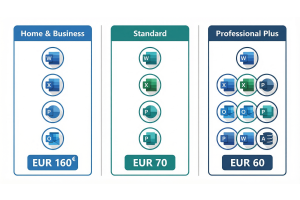
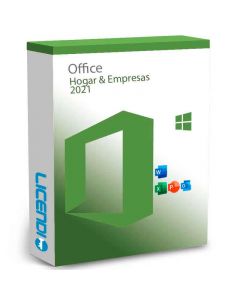
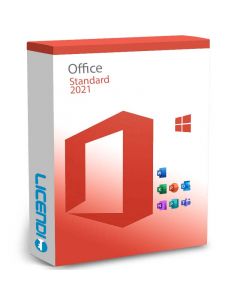
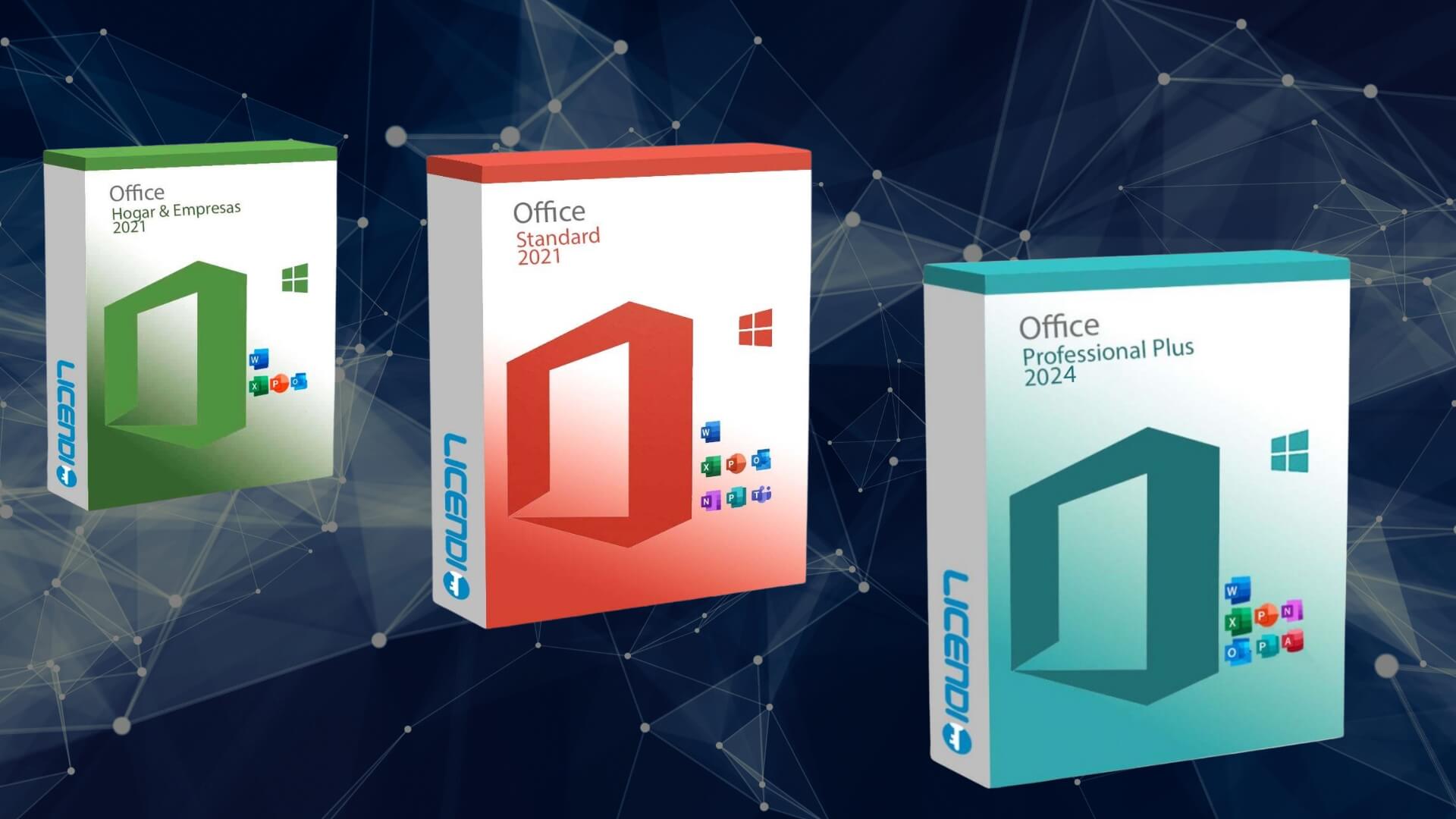
Office applications (word processors, spreadsheets, email, etc.) are essential in any business. Although suites such as Microsoft 365 (formerly Office 365) push the subscription model, Microsoft still offers versions of Office with a perpetual license (e.g., Office 2021 Home and Business or the Office LTSC edition for enterprises). For a typical SME in Spain, whose users primarily need basic Word, Excel, PowerPoint, and Outlook, buying Office 2021 as a one-time payment (~€250 per license) can be more economical than paying ~€12 monthly per user with Microsoft 365 Business Standard. Additionally, a perpetual license avoids the need to manage user accounts in Microsoft's cloud or depend on connectivity for license validation; the software remains locally installed and under company control.
A real-world case: A Madrid accounting firm with 10 employees decided in 2023 to acquire 10 perpetual licenses of Office 2021 instead of subscribing to Microsoft 365. They paid approximately €2,500 in total just once, whereas the subscription would have cost them nearly €3,960 over three years. After two years of usage, the firm already achieved significant savings in software costs and eliminated concerns about monthly renewals. This example demonstrates why, for stable office software, a perpetual license is highly beneficial.
Creative and Design Software (Alternatives to Adobe)
In the fields of graphic design, photo editing, and video editing, Adobe Creative Cloud has become the industry standard but offers only subscriptions (since 2013, Adobe no longer sells perpetual licenses for programs like Photoshop or Illustrator). This has fostered the emergence of very appealing alternatives with perpetual licenses for users who prefer to buy software outright.
A notable example is Serif's Affinity Suite: professional applications such as Affinity Photo (photo editing), Affinity Designer (vector graphics), and Affinity Publisher (desktop publishing) are available for a one-time payment. Indeed, Affinity 2's universal license offers all three applications with perpetual licenses for Windows, Mac, and iPad for under €180 per user. Other examples of perpetual-licensed creative software include CorelDRAW Graphics Suite (which maintains a one-time purchase option in addition to annual subscription), DaVinci Resolve Studio for video editing (lifetime license around €300), and even Final Cut Pro in the Mac ecosystem (~€350 one-time payment). Many small design agencies have opted for these tools to reduce recurring costs without sacrificing capabilities. Beyond savings, these alternatives simplify user and license management.
For instance, Adobe Creative Cloud requires businesses to use the Adobe Admin Console (online business console) to assign or revoke licenses for each user, manage corporate Adobe IDs, etc., adding administrative complexity. In contrast, perpetual tools simply require installing the software on each computer with a product key, independent from any central console or cloud accounts. This streamlines IT work and grants the company greater autonomy in its creative workflow.
CAD, 3D Design, and Engineering Tools
In engineering and architecture sectors, traditionally expensive perpetual licenses for CAD/CAE software were purchased. In recent years, giants like Autodesk have shifted entirely to a subscription model (e.g., Autodesk AutoCAD is now available only via annual rental). However, there are still alternatives and scenarios where perpetual licensing prevails. One example is SOLIDWORKS, widely used in mechanical design: this software offers perpetual licenses for businesses, with a one-time payment for the current version and an option for annual maintenance to receive updates. Many industrial companies purchase SOLIDWORKS licenses, possibly maintain 2-3 years of support, but can continue using their version indefinitely without further costs. The value here is that the company ensures critical tools remain operational regardless of circumstances, and can plan updates according to their technical and budgetary convenience. Other cases are more affordable AutoCAD alternatives, like BricsCAD or ZWCAD, offering perpetual sales models. These enable small architectural firms or technical workshops to acquire DWG-compatible design software for a one-time fee, avoiding high Autodesk subscriptions. The initial investment amortizes over time, as these companies will use the software for years in their projects. Administratively, once licenses are installed on engineers' computers, there's no need for online account management; companies simply monitor their installations based on purchased licenses.
Business Management Software (ERP, Accounting, CRM)
Many business software solutions offer both cloud subscription options and on-premise (locally installed) versions with perpetual licenses. In Spain, for instance, many SMEs from various sectors have opted to purchase permanent licenses for accounting and invoicing programs, avoiding monthly fees. Popular suites such as Sage 50cloud (the evolution of Contaplus) allow indefinite licenses installed on company servers, and similarly, Microsoft Dynamics 365 in its on-premise edition (formerly Dynamics NAV) provides perpetual licensing. The company benefits doubly: maintaining sensitive data locally under direct control and making a one-time payment as a capital expenditure (CAPEX) rather than recurring operational expenses (OPEX). For example, an SME with 20 users found that a cloud ERP version would cost approximately €2,000 monthly (€24,000 annually), whereas a local perpetual license implementation cost around €50,000 one-time. Although the initial investment was higher, within two years the perpetual option was already cheaper in cumulative costs, with the added benefit of technological autonomy: the company decides when to update and integrate the system, free from cloud vendor dependence.

Frequently Asked Questions (FAQ)
What is a perpetual software license?
It is a licensing model in which you pay once for the software and obtain the right to use it indefinitely. Unlike a subscription (which expires if not renewed), a perpetual license lets you use the purchased version of the program with no time limit and without recurring payments.
What are the advantages of a perpetual license for businesses?
Businesses gain several benefits: long-term cost control (no ongoing payments, usually becoming cheaper after a few years), stability and continuous availability (no risk of critical tools ceasing operation due to non-payment), vendor independence (continued usage even if the manufacturer changes conditions), and flexibility in deciding when to update. It also simplifies internal license management and allows keeping data and systems under the company's own control, highly valued for security and regulatory compliance reasons.
What types of software can be purchased with a perpetual license in 2025?
Many types still exist. For instance, office suites like Microsoft Office in their one-time purchase versions; creative tools that serve as Adobe alternatives (Affinity Photo, Affinity Designer, CorelDRAW, Final Cut Pro, etc.); CAD/CAE software such as SOLIDWORKS (and other mechanical design programs) that still offer perpetual licenses; local business management software (ERP/accounting) installed on-premise; server operating systems, databases, and traditional infrastructure software. It is advisable to review case by case, as some manufacturers have moved to subscriptions, but perpetual alternatives generally remain available in most categories.
When is a perpetual license more advantageous than a subscription?
In general, choosing a perpetual license is advantageous when planning to use the software long-term without needing constant cutting-edge updates. If subscription costs would surpass the one-time license cost within, say, 2 or 3 years, it typically indicates that a perpetual license is a better investment. It is also advisable in stable environments (for instance, industrial production or offices with highly stable needs) and when seeking to avoid dependence on internet connectivity and vendor policies. If the company values total control over the tool and its data and prefers a fixed expense now rather than indefinite payments, a perpetual license is the ideal choice.