EN
EN FR
FR  DE
DE  IT
IT  PT
PT  ES
ES 

How to Take a Screenshot?
Step 1: Capture the Image
 Windows provides six methods to take a screenshot. Three require the Print Screen (PrtScn) key, while the rest require the Windows (Win) key.
On external keyboards, you'll find a PrtScn key located in the top right corner. The Win key usually resides in the bottom left corner between the Control (Ctrl) and Alternate (Alt) keys. It has the Windows logo, so it's easy to identify.
On laptops, the Print Screen command may be combined with another function on a single key, as shown above. In this case, you must press the Function (Fn) key in addition to the Print Screen key.
Here we break down the six screenshot commands:
- Print Screen (PrtScn): captures the entire screen. If you have more than one screen, this function captures everything displayed on all connected screens as a single image. By default, it does not save your image as a file, but simply sends the content to the clipboard.
- Alt + Print Screen: captures a single window. Make sure to highlight the target window first, such as a document or browser, before pressing these keys. By default, it also does not save the image as a file, but sends it to the clipboard.
- Win + Print Screen: captures the full screen. The difference is that Windows saves the image as a file. By default, it is sent to C: Users
Images Screenshots on your PC. - Win + Shift + S: takes a screenshot with the built-in Snip & Sketch tool. The screen dims and offers four options in a small toolbar: rectangular, freeform, window, and full screen. It also does not save screenshots as an image, but sends them to the clipboard. We will detail this function later.
- Win + G: opens the game bar. Click on the screenshot button and this tool will save an image in C: Users
VideosCaptures by default. To use this tool, the game bar must be activated in Settings> Games> Game bar. - Win + Alt + Print Screen: captures the entire screen. Saves an image in C: Users
VideosCaptures by default. To use this tool, make sure the game bar's screenshot function is activated in Settings> Games> Game bar.
In some cases, the screen flashes or dims to indicate that Windows took a screenshot. If this does not happen, open File Explorer and head to the default locations to see if Windows saved the image.
 If you use OneDrive, you can save screenshots to the cloud so they are accessible from all your devices. It does not do this by default, but you must right-click on the cloud icon parked next to the system clock and click on Settings in the pop-up menu. Then, press the Backup tab in the resulting pop-up window and check the box in Screenshots.
In this case, you can press the first three Print Screen commands to automatically save an image in OneDrive. You will not see the screen flash or dim, but you will receive a notification. Make sure to sync the Screenshots folder if you want to access the images on your PC.
Step 2: Open the Paint Program
 If you used a method that saves the screenshot locally as a file, you can locate and view the image using the Photos app. If it worked, you can move it, attach it to an email, upload it to the cloud, etc. However, if you need to crop an image, especially those taken on PCs with more than one screen, you have three native tools at your disposal: Paint, Paint 3D, and Photos.
Compared to Paint and Paint 3D, Microsoft's new Photos app is limited. You can rotate and crop images, change the aspect ratio, apply filters, adjust the colour, remove red eyes, and more. However, you cannot draw, paint, create an image from scratch, or paste from the clipboard.
In this guide, we use the Paint program because it is familiar and reliable. By default, you will not find it in the Start menu. Instead, type Paint in the field on the taskbar and click on the resulting desktop application.
Paint may also be available when you right-click on an image. When the pop-up menu appears, move the mouse pointer over the Open with option in the menu to find Paint, as we show you below.
 You can also locate the program (mspaint.exe) in the C: WindowsSystem32 directory. Right-click on the file and select Pin to start in the pop-up menu.
Step 3: Paste the Screenshot (Clipboard Methods Only)
 You will need to follow this step if you used any of the methods that sent the screenshot to the clipboard.
With Paint open, click on the Clipboard-style Paste button, located in the top left corner. You can also press the Ctrl and V keys on the keyboard to paste the image onto Paint's blank canvas, which will expand as required.
With the screenshot correctly inserted into Paint, you can crop, paint, create shapes, add text, and more. If you want to add stickers, 3D shapes, effects, and more, click on the Edit with Paint 3D button, located on the far right of the toolbar.
Step 4: Save the Screenshot
 This step applies to all screenshot methods.
When you finish editing the image, click on the main File option in the top left corner. Then select Save as from the drop-down menu. This option expands with a selection of four file formats: PNG, JPEG, BMP, and GIF, along with the Other formats option to save your image as a TIFF or HEIC file.
If you are not familiar with image formats, check out our JPEG vs. PNG guide.
It's that easy!
Alternatives
Snipping Tool
 The best alternative method is Windows 10's native snipping tool. The built-in screenshot utility in Windows works quite well, but it's not the most robust or versatile when it comes to saving an image. However, the snipping tool is quite useful as it allows users to better define and capture the part they want of their desktop screen as an image, without the need for a keyboard. It's not as fast as just pressing Print Screen, but it's much more accurate.
To start, simply type Snipping Tool in the taskbar's search field and select the resulting application. Once it opens, you'll see an update notification. Snipping Tool is still an available tool, but Microsoft encourages you to use Snip & Sketch or the Win + Shift + S keyboard shortcut.
With the tool open, click on the Mode button to expand the menu. You'll find four screenshot capture options: Draw a window (Free-form Snip), box in an area (Rectangular Snip), capture the current window (Window Snip), and capture the entire screen (Full-screen Snip).
If you use the free-form and rectangular modes, the screen turns white. Once you start defining the screenshot capture space, the white tint will be erased within that area. If you're capturing a specific window, your screen will tint white, except for the content within that window.
The snipping tool also includes a delay function. You can wait between one and five seconds before taking a screenshot so you can capture a precise moment in a video or animation. You can then take repeated snips in the same mode simply by pressing the Alt + N keys.
Once you take a screenshot, the Snipping Tool interface expands to display the screenshot. You can make light edits, such as using a pen, highlighter, and eraser. You can also click on the Paint 3D button to make additional edits in the newer application.
When you're finished editing within the snipping tool, click on File in the top left corner and then click on the Save as option, which appears in the drop-down menu.
Snip & Sketch
 Snip & Sketch is Microsoft's latest option. You can access it from the Start Menu, or with the Win + Shift + S keys on your keyboard.
If you use the keyboard shortcut, the screen will darken and you'll see a toolbar with five buttons at the top. You'll have the same functions as the Snipping Tool, but your captures will not be saved as a file. Instead, the image goes directly to the clipboard.
If you open the Snip & Sketch app, click on New in the top left corner, and choose Snip now from the drop-down menu. The screen will darken and the toolbar with five buttons will appear. In this case, the capture will load within the app, allowing you to crop the image and make modifications.
When you're ready, save the image to your PC by clicking on the button that looks like a disk. If you prefer to edit and save the image with another program, click on the three-dot icon in the toolbar and choose the Open with option.
How to Take a Screenshot in Windows 11
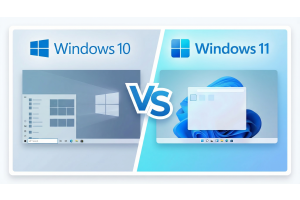
 Windows 11 is now available to the public. When you upgrade your PC to the latest version of Microsoft's operating system, you'll surely want to continue taking screenshots. Don't worry too much; the steps are the same as in Windows 10.
Following the detailed instructions above, you can use Paint, Print Screen, Snipping Tool, or Snip & Sketch.
Third-Party Programs
If you're looking for more options to customise your screenshots (and don't mind downloading a new app), we suggest trying LightShot. The LightShot app may be a better option for more professional work or screenshots that require significant editing.
We also suggest the GNU Image Manipulation Program or GIMP. It's an open-source tool for users who don't want to pay for an Adobe Photoshop subscription. It provides everything you need to create illustrations, edit high-definition images, and more.