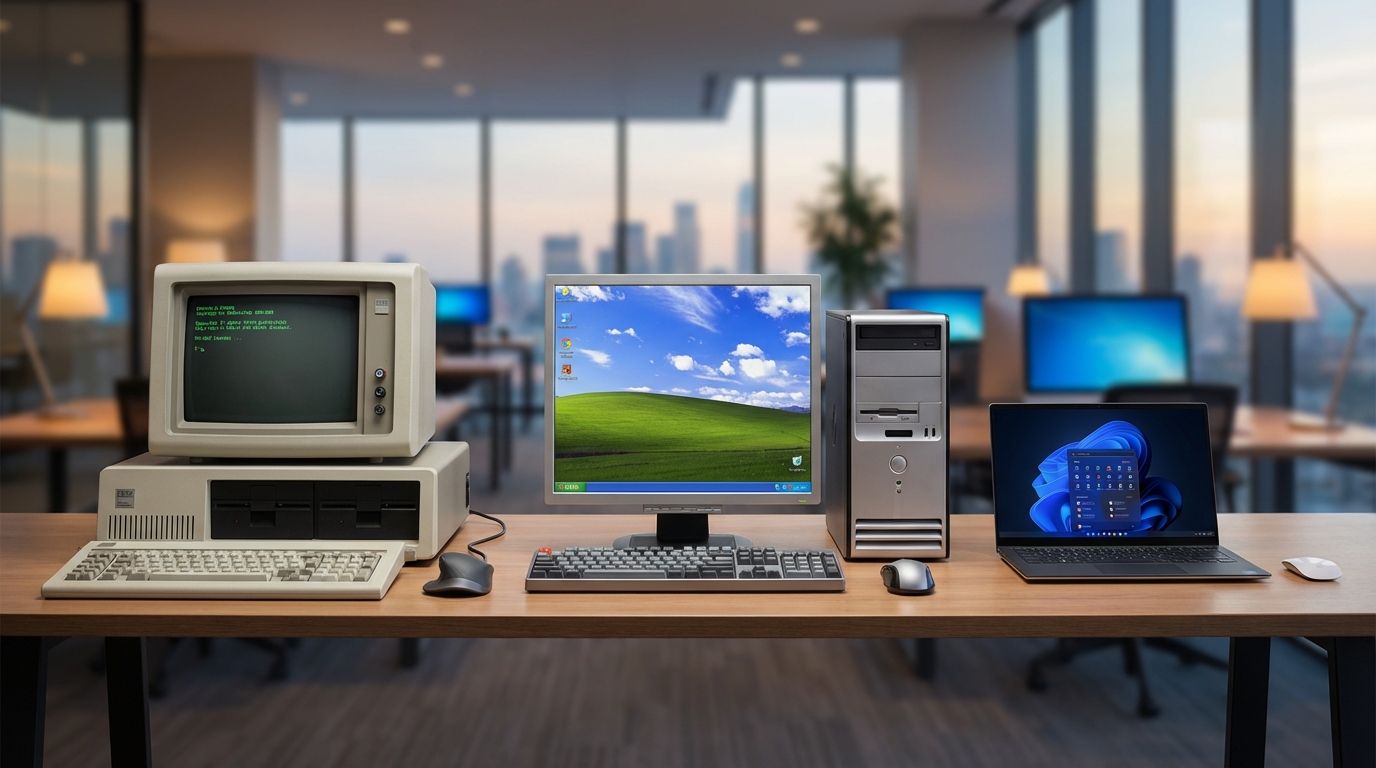
Evolution of Microsoft computing from DOS to Windows 11 showing different generations of PCs

The history of Microsoft software licensing spans over four decades, transforming from simple floppy disk distribution to sophisticated cloud-based subscription models. Understanding this evolution is essential for businesses and consumers who want to make informed decisions about their software investments. From the garage startup days of Bill Gates and Paul Allen to the global enterprise giant we know today, Microsoft's licensing strategies have shaped how the entire software industry approaches intellectual property protection, distribution, and monetization.

This comprehensive guide explores the complete history of Microsoft licensing, examining key milestones, legal battles, and the innovations that have defined each era. Whether you are an IT professional managing enterprise licenses, a small business owner looking to optimize software costs, or simply curious about how software licensing evolved, this article provides valuable insights into one of technology's most important business models.

Table of Contents

The Early Days: MS-DOS and the Birth of Software Licensing (1975-1989)

Vintage 1980s IBM PC with green phosphor monitor displaying MS-DOS
The IBM PC era established the foundation for software licensing as we know it today

Microsoft's licensing story begins in 1975 when Bill Gates and Paul Allen founded the company in Albuquerque, New Mexico. Their first product, a BASIC interpreter for the Altair 8800 microcomputer, immediately faced the challenge that would define the software industry: piracy. Gates famously wrote his "Open Letter to Hobbyists" in 1976, arguing that software developers deserved to be paid for their work, a revolutionary concept at the time when many believed software should be freely shared.

The pivotal moment in Microsoft's licensing history came in 1980 when IBM approached the company to provide an operating system for its upcoming personal computer. Microsoft purchased QDOS (Quick and Dirty Operating System) for approximately $50,000 and licensed it to IBM as PC-DOS. Crucially, Microsoft retained the rights to sell the operating system independently as MS-DOS. This decision proved to be one of the most significant business moves in computing history.

The licensing model Microsoft established with IBM was groundbreaking. Rather than selling the software outright, Microsoft licensed it on a per-computer basis. This meant that every IBM PC clone manufacturer needed to pay Microsoft for each computer sold. By 1984, MS-DOS was running on millions of computers worldwide, and Microsoft's licensing fees generated substantial recurring revenue.

During this era, software was typically distributed on floppy disks, and licensing was primarily based on trust. Users received a physical product with a manual that contained license terms, but there was no technical mechanism to prevent unauthorized copying. Software piracy was rampant, and companies like Microsoft relied primarily on corporate customers who were willing to pay for legitimate licenses and support.

The late 1980s saw Microsoft introduce more sophisticated licensing approaches. Site licenses became available for organizations, allowing them to install software on multiple computers for a negotiated fee. This was the precursor to modern volume licensing programs and represented Microsoft's recognition that enterprise customers had different needs than individual consumers.

The Windows Revolution: Mass Consumer Licensing (1990-2000)

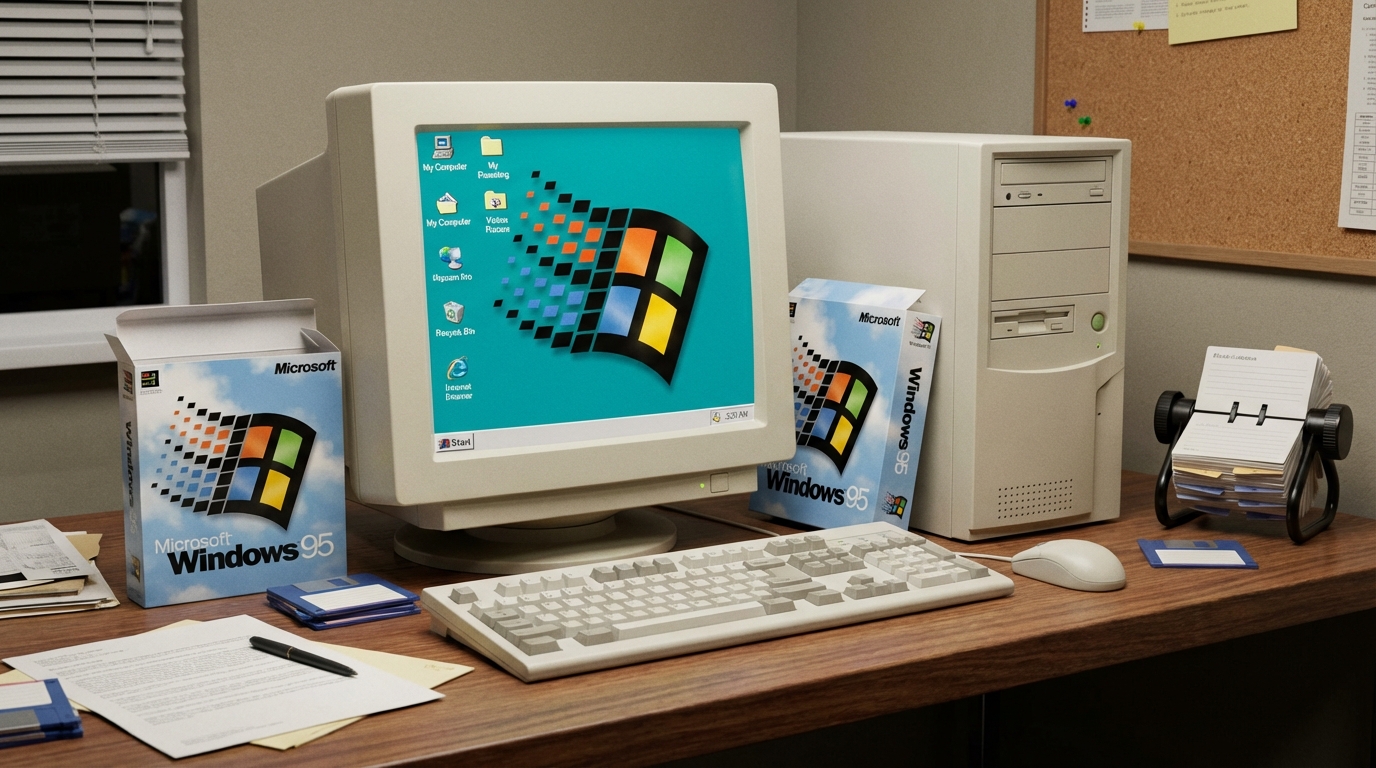
Windows 95 desktop displayed on CRT monitor with retail box visible
Windows 95 revolutionized software retail with its massive launch campaign

The release of Windows 3.0 in 1990 marked Microsoft's transition from a primarily B2B company to a consumer powerhouse. With its graphical interface and improved usability, Windows attracted millions of home users who purchased shrink-wrapped software from retail stores. This created new licensing challenges and opportunities.

Microsoft introduced the concept of OEM (Original Equipment Manufacturer) licensing during this period. Computer manufacturers could pre-install Windows on new machines, paying Microsoft a licensing fee for each unit sold. This strategy proved incredibly effective, as consumers increasingly expected their new computers to come with Windows pre-installed. By the mid-1990s, OEM licensing accounted for the majority of Windows revenue.

The launch of Windows 95 on August 24, 1995, was a cultural phenomenon. People lined up outside stores at midnight to purchase the new operating system, which retailed for $209.95 for the full version or $109.95 as an upgrade. This release established several licensing practices that would persist for decades, including the distinction between full retail licenses and upgrade licenses.

Windows 95 also introduced the Certificate of Authenticity (COA), a holographic sticker attached to physical products to help users identify legitimate software. This was one of Microsoft's first anti-piracy measures built into the licensing model. The 25-character product key became standard, though at this time it was only used for installation and not for activation purposes.

Microsoft Office, initially released in 1990, became another licensing success story. The Office suite bundled Word, Excel, and PowerPoint, offering better value than purchasing applications individually. Enterprise licensing for Office grew significantly as businesses standardized on Microsoft's productivity suite. Volume licensing agreements allowed companies to deploy Office across thousands of computers with centralized license management.

The late 1990s brought Windows 98 and Windows 2000, each refining the licensing model. Windows 2000, designed for business users, introduced Client Access Licenses (CALs) for server products. Organizations needed to purchase a CAL for each device or user that accessed Windows Server, Exchange Server, or SQL Server. This per-seat or per-device licensing model remains fundamental to Microsoft's enterprise offerings today.

Windows XP and the Activation Era (2001-2006)

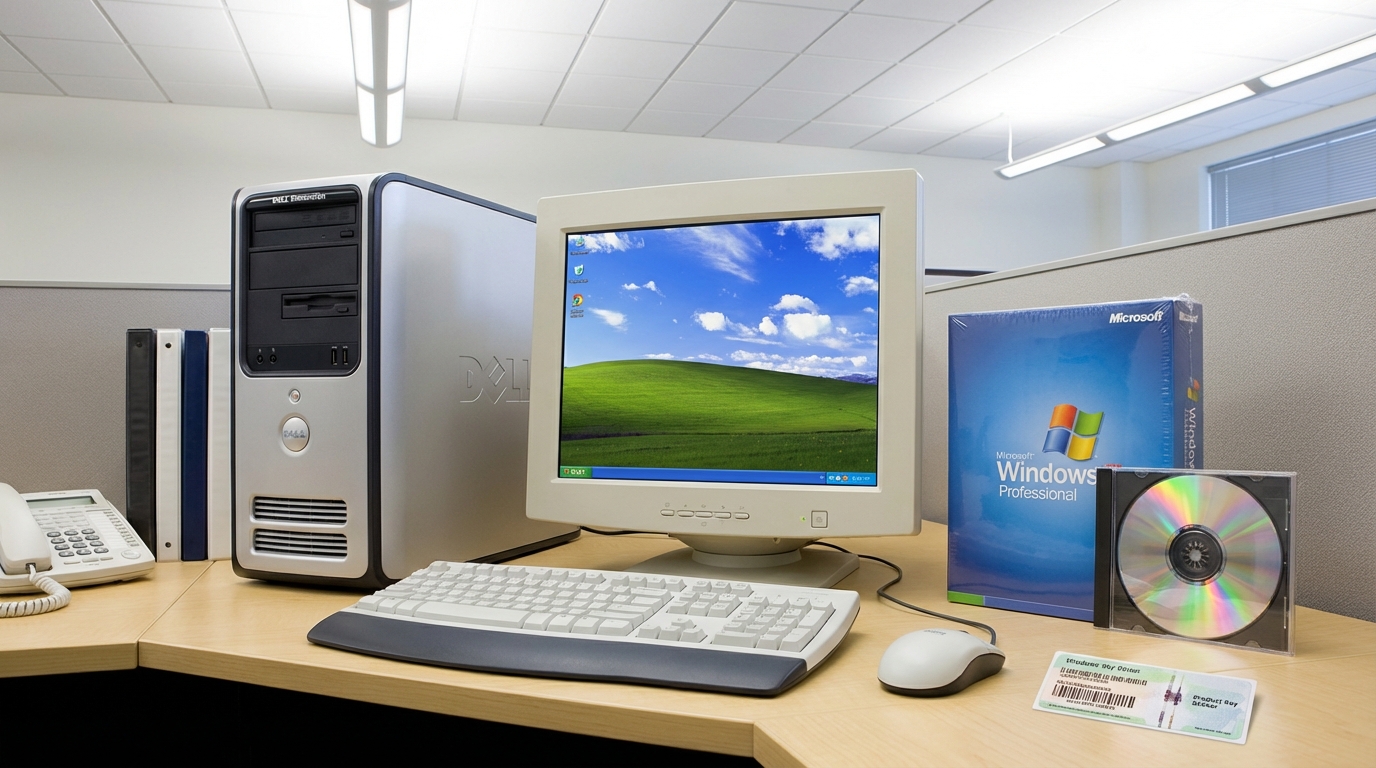
Windows XP desktop with green hills wallpaper and retail box showing product key
Windows XP introduced mandatory product activation, fundamentally changing software licensing

Windows XP, released on October 25, 2001, represented a watershed moment in software licensing with the introduction of Windows Product Activation (WPA). For the first time, Microsoft required users to activate their software within 30 days of installation, either online or by telephone. This technical enforcement mechanism was designed to combat piracy by ensuring that each product key was used on only one computer.

Product activation worked by creating a hardware hash based on the computer's components and transmitting it to Microsoft's servers. If the same product key was used on a different computer, activation would fail. Users who made significant hardware changes to their computers sometimes needed to reactivate, which occasionally caused frustration but significantly reduced casual piracy.

The introduction of activation was controversial. Privacy advocates worried about Microsoft collecting hardware information, while some users complained about the inconvenience of needing to reactivate after hardware upgrades. Despite these concerns, activation became standard practice throughout the software industry.

Windows XP also refined the distinction between retail, OEM, and volume license versions. Retail licenses could be transferred to a new computer after removing the software from the old one. OEM licenses, pre-installed by computer manufacturers, were permanently tied to the original hardware. Volume licenses, used by enterprises, typically did not require individual activation and could be deployed using a single volume license key (VLK).

The Windows Genuine Advantage (WGA) program, introduced in 2005, added another layer of anti-piracy protection. WGA validated the legitimacy of Windows installations and was required to download certain updates and software from Microsoft. Computers running non-genuine Windows displayed persistent notifications encouraging users to purchase legitimate licenses.

Microsoft's licensing revenue grew substantially during this period. The combination of activation technology, aggressive pursuit of software pirates, and growing enterprise adoption made Windows XP one of the most commercially successful software products in history. By 2006, Windows XP was running on over 400 million computers worldwide.

Enterprise Licensing and Volume Programs (2000-2015)

Modern enterprise server room with blue LED lights and Windows Server management interface
Enterprise server licensing became increasingly complex as organizations scaled their infrastructure

As organizations' technology needs grew more complex, Microsoft developed sophisticated volume licensing programs to address enterprise requirements. The Microsoft Volume Licensing (MVL) program offered multiple agreement types tailored to organizations of different sizes and needs.

Open License, introduced in the late 1990s, allowed small and medium businesses to purchase licenses in quantities of five or more with volume discounts. Select License targeted larger organizations with 250 or more users, offering greater discounts and more flexible terms. Enterprise Agreement (EA), designed for the largest customers, provided organization-wide licensing with simplified management and maximum discounts.

Software Assurance (SA) became a key component of enterprise licensing. Introduced with Windows 2000, SA provided upgrade rights, support, training, and deployment planning tools for an annual fee. Organizations with SA automatically received new versions of licensed software, ensuring they always had access to the latest features and security updates.

The Server licensing model evolved significantly during this period. Windows Server moved from per-server to per-processor licensing, then eventually to per-core licensing. SQL Server and other enterprise products followed similar trajectories. Understanding licensing requirements became increasingly complex, leading to the growth of specialized licensing consultants and compliance services.

Microsoft introduced the Service Provider License Agreement (SPLA) to address the needs of hosting providers and cloud service providers. SPLA allowed these organizations to license Microsoft software on a monthly basis based on usage, enabling them to build services on Microsoft technology without massive upfront investments.

The complexity of Microsoft licensing created both opportunities and challenges. Organizations often struggled to understand their licensing requirements, leading to either over-purchasing or under-licensing. Microsoft responded by developing tools like the Microsoft Assessment and Planning Toolkit (MAP) to help organizations inventory their software and determine licensing needs.

Windows 10, Windows 11 and Modern Licensing (2015-Present)

Modern Microsoft ecosystem with Surface laptop, tablet, and smartphone showing Windows 11
The modern Microsoft ecosystem emphasizes cross-device licensing and cloud integration

Windows 10, released on July 29, 2015, represented a fundamental shift in Microsoft's licensing philosophy. For the first time, Microsoft offered a free upgrade to users of Windows 7 and Windows 8.1, valid for one year after release. This move was designed to accelerate adoption and unify the Windows ecosystem on a single platform.

The "Windows as a Service" concept introduced with Windows 10 changed how operating systems were updated and licensed. Rather than releasing major new versions every few years, Microsoft committed to continuous updates delivered through Windows Update. This model eliminated the traditional upgrade cycle and associated licensing decisions.

Digital licensing (formerly called digital entitlement) simplified the activation process. When users upgraded to Windows 10 or purchased a device with Windows 10 pre-installed, their license was stored in Microsoft's servers and linked to their hardware. Reinstalling Windows on the same device activated automatically without needing to enter a product key.

Microsoft 365, launched in 2017, marked the company's most significant licensing transformation. This subscription service bundled Office applications, cloud storage, and other services for a monthly or annual fee. Rather than purchasing perpetual licenses, users paid ongoing fees for continuous access to the latest software. Microsoft 365 proved enormously successful, particularly for businesses that appreciated predictable software costs and automatic updates.

Windows 11, released in October 2021, continued the licensing patterns established by Windows 10. Free upgrades were available for compatible Windows 10 devices, though stricter hardware requirements (including TPM 2.0) limited eligibility. The licensing options remained similar: retail licenses for individual purchases, OEM licenses for new computers, and volume licenses for enterprises.

The shift toward subscription licensing accelerated during this period. While perpetual licenses for Office products remain available, Microsoft increasingly promoted Microsoft 365 as the preferred option. This represented a fundamental change in the software business model, from one-time purchases to recurring revenue streams.

EU Legal Rulings on Second-Hand Software Licenses

Legal documents and EU court materials on professional desk representing software licensing law
EU court rulings established the legal foundation for second-hand software sales

The European Union has played a crucial role in shaping software licensing practices, particularly regarding the resale of used software licenses. The landmark UsedSoft v. Oracle case, decided by the European Court of Justice (ECJ) on July 3, 2012, fundamentally changed the legal landscape for software licensing in Europe.

In this case, the ECJ ruled that the principle of exhaustion applies to software licenses. This means that once a software copyright holder has sold a copy of software within the EU, they cannot prevent the resale of that copy. The ruling applied to both physical copies and downloaded software, establishing that the first sale doctrine extends to digital goods.

The implications were significant. Organizations that had purchased Microsoft licenses but no longer needed them could legally resell those licenses to other companies. This created a legitimate secondary market for software licenses, offering cost savings of up to 70% compared to new license prices. Companies like Licendi specialize in providing these legal second-hand Microsoft licenses to businesses across Europe.

Microsoft initially resisted the implications of the UsedSoft ruling but eventually adapted its licensing programs. The company updated its licensing terms to address the resale of licenses while maintaining requirements that sellers must completely delete software before transfer and that volume license agreements must be handled appropriately.

Subsequent cases reinforced and refined the UsedSoft ruling. In 2016, the German Federal Court (BGH) confirmed that volume licenses could be split and individual licenses resold, further expanding the scope of the secondary market. These rulings have created a thriving market for used software licenses in Europe, offering legitimate cost-saving opportunities for businesses of all sizes.

The legal framework in the European Union differs significantly from other regions. In the United States, the first sale doctrine has been applied more narrowly to software, and license transfer rights are primarily determined by contractual terms. Organizations operating internationally must understand these regional differences when managing their software licenses.

The Future of Microsoft Licensing

Futuristic office with holographic displays representing cloud-based software licensing future
The future of licensing points toward cloud-based, AI-integrated subscription models

The future of Microsoft licensing is increasingly centered on cloud services and artificial intelligence. Microsoft Azure, the company's cloud computing platform, uses consumption-based licensing where organizations pay for resources as they use them. This model eliminates the need for upfront license purchases and provides flexibility to scale resources up or down based on demand.

Artificial intelligence is becoming integrated into Microsoft's licensing strategy. The introduction of Microsoft Copilot, an AI assistant powered by large language models, created new licensing requirements. Copilot is offered as an add-on to Microsoft 365 subscriptions, establishing a precedent for AI-enhanced productivity tools as a premium licensed feature.

Microsoft's per-core licensing for server products continues to evolve. In 2022, Microsoft introduced changes to licensing Windows Server and SQL Server in virtualized environments, particularly when running on competitors' cloud platforms. These changes encouraged organizations to use Microsoft Azure for their workloads, demonstrating how licensing can be used as a competitive tool.

Sustainability and environmental considerations are beginning to influence licensing decisions. Extended security updates for older products like Windows 10 (which reaches end of support in October 2025) allow organizations to delay hardware upgrades, reducing electronic waste. However, the premium pricing for extended support creates incentives to migrate to newer versions.

The tension between subscription and perpetual licensing is likely to continue. While Microsoft clearly prefers subscription models for their predictable revenue streams, customer demand for perpetual licenses ensures they will remain available for the foreseeable future. Organizations must evaluate their specific needs to determine which licensing model offers the best value.

Frequently Asked Questions

Can I transfer my Microsoft license to a new computer?

Retail licenses can be transferred to a new computer after removing the software from the old one. OEM licenses, which come pre-installed on computers, are permanently tied to the original hardware and cannot be transferred. Volume licenses have specific transfer rules defined in the licensing agreement.

What is the difference between Microsoft 365 and Office perpetual licenses?

Microsoft 365 is a subscription service that includes Office applications, cloud storage, and other services for a monthly or annual fee. Perpetual licenses like Office 2021 or Office 2024 require a one-time payment and provide permanent rights to use that version. Microsoft 365 receives continuous updates while perpetual licenses only receive security updates.

Is it legal to buy used Microsoft licenses?

Yes, in the European Union, the 2012 UsedSoft ruling established that properly acquired software licenses can be legally resold. The seller must delete all copies of the software, and the license must be properly transferred. Reputable dealers like Licendi ensure compliance with all legal requirements.

What are Client Access Licenses (CALs)?

CALs are licenses required to access Microsoft server products like Windows Server, Exchange Server, or SQL Server. Each user or device that accesses the server needs a CAL. Organizations can choose between User CALs (allowing one user to access from any device) or Device CALs (allowing one device to be used by any number of users).

How does Windows digital licensing work?

Digital licensing stores your Windows activation in Microsoft's servers, linked to your device's hardware. When you reinstall Windows on the same device, it activates automatically without requiring a product key. You can also link your digital license to your Microsoft account for easier recovery.

Looking to save on Microsoft software licenses? At Licendi, we offer legal second-hand Microsoft licenses at prices up to 70% lower than retail. All our licenses comply with EU regulations and come with full support. Browse our selection of Microsoft Office licenses today and discover how much your business can save.