EN
EN FR
FR  DE
DE  IT
IT  PT
PT  ES
ES 


Windows Usage Statistics in 2026
Windows remains the dominant operating system in the desktop computer market in 2026. With over 1.4 billion active devices worldwide, Microsoft's ecosystem continues to lead the sector, although the transition to Windows 11 presents significant challenges for both home users and businesses. In this article, we will analyze the most recent statistics on Windows usage, including adoption data, market share by version, and projections for the near future.
Table of Contents
- Desktop Operating System Market Overview
- Windows Version Market Share
- Windows 11 Adoption in 2026
- Windows 10 End of Support
- Windows in Gaming Statistics
- Windows in the Enterprise Market
- Regional Trends
- Projections for 2026-2027
- Frequently Asked Questions
Desktop Operating System Market Overview
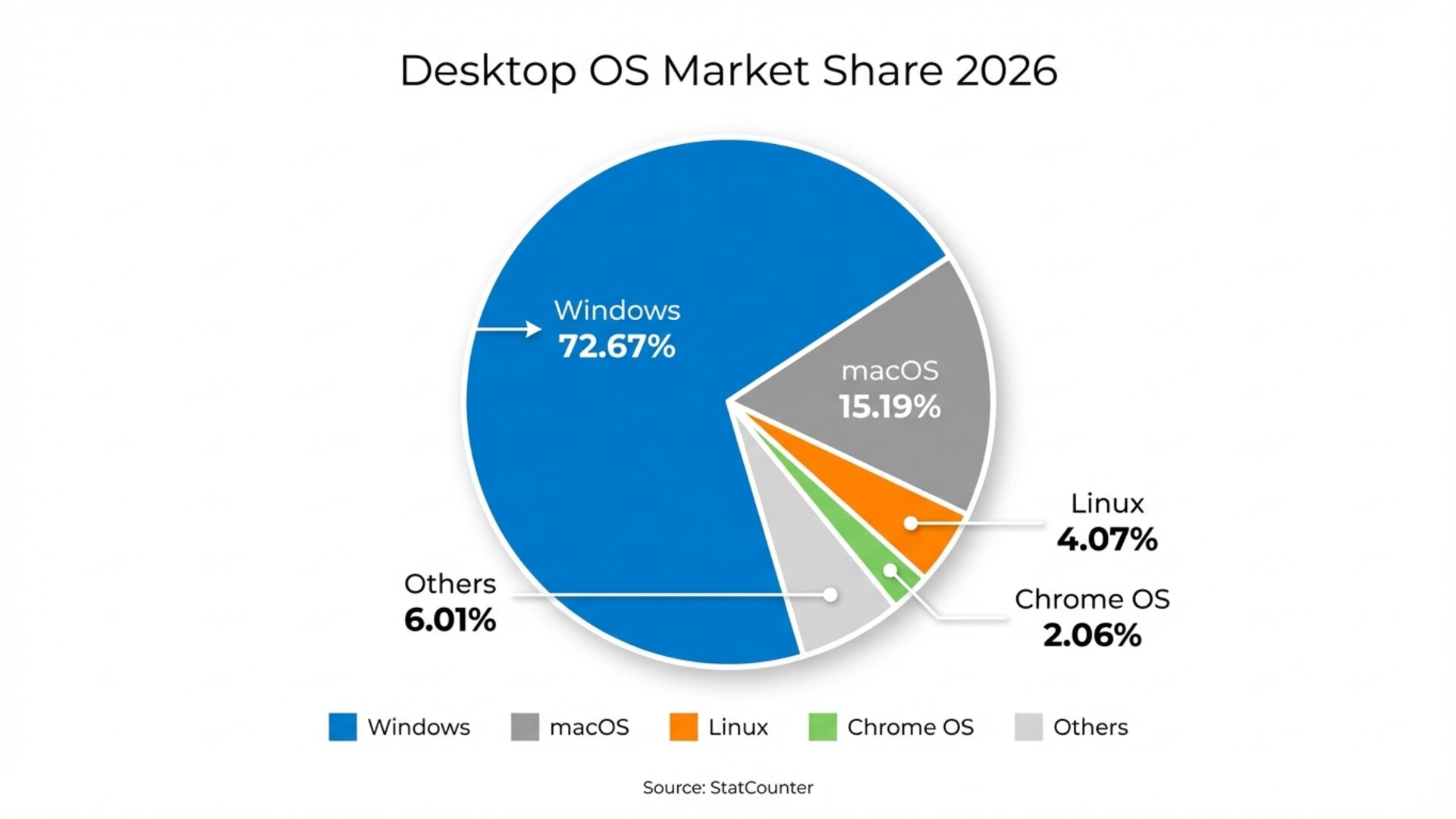
The desktop operating system market in 2026 maintains a structure clearly dominated by Microsoft Windows. According to the most recent data collected by StatCounter during the period from January 2024 to February 2025, Windows holds a global market share of 72.67% on desktop devices. This figure, while impressive, represents a slight decrease compared to previous years, when Windows exceeded 75% of the market.
The current distribution of the global desktop operating system market is as follows:
- Windows: 72.67% of the global market
- macOS: 15.19% of the global market
- Linux: 4.07% of the global market
- Chrome OS: 2.06% of the global market
- Others: 6.01% (includes unidentified systems)
It's important to note that these percentages vary significantly by geographic region and sector of use. For example, in markets such as Europe and North America, the macOS share tends to be higher, while in regions like Asia and Latin America, Windows maintains an even more dominant presence, exceeding 80% of the local market in some cases.
Windows Version Market Share
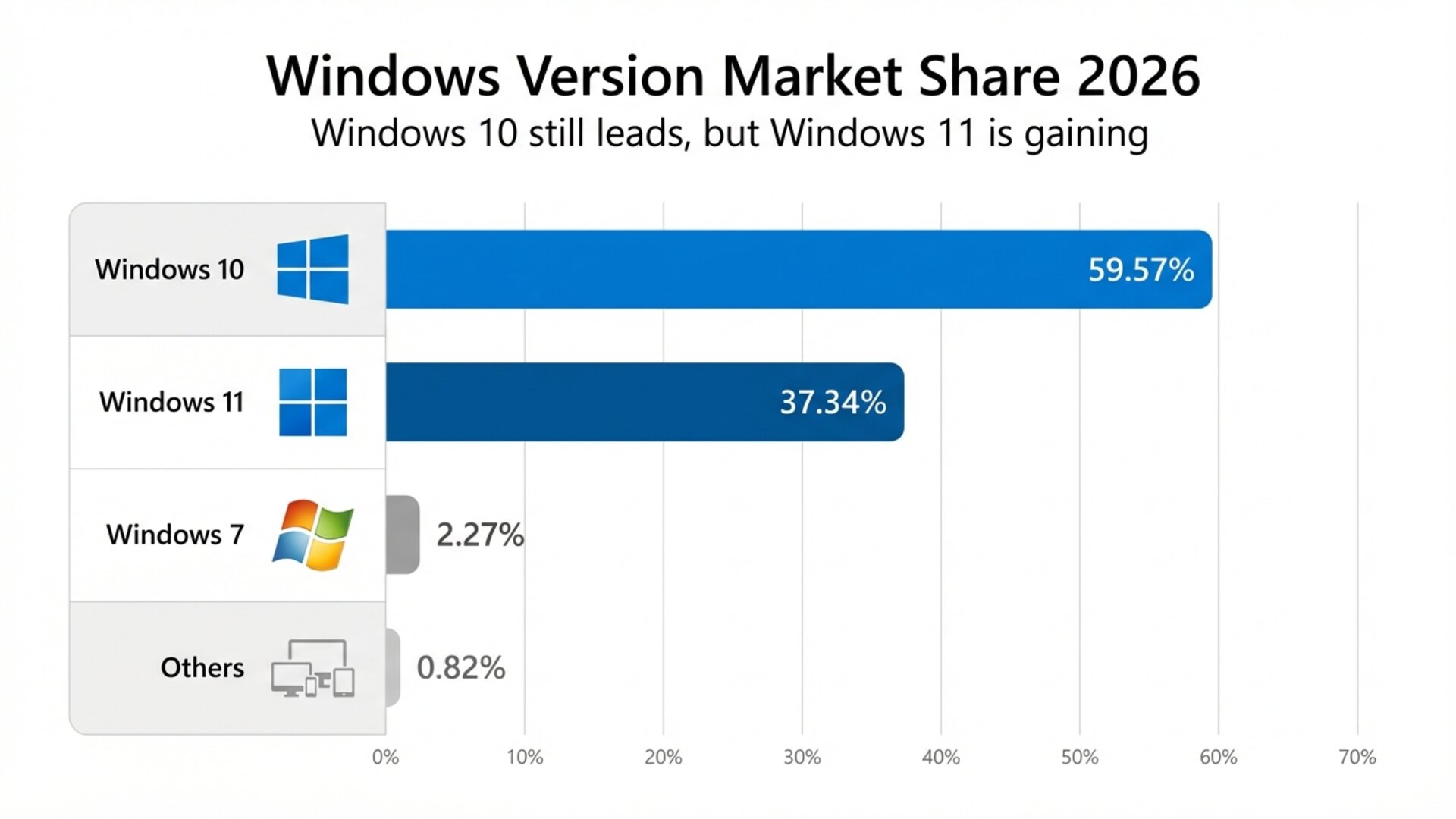
Within the Windows ecosystem, the distribution among different versions reveals a complex picture of the ongoing technological transition. StatCounter data for January-February 2025 shows the following distribution among Windows versions:
- Windows 10: 59.57% of all Windows devices
- Windows 11: 37.34% of all Windows devices
- Windows 7: 2.27% of all Windows devices
- Windows 8.1: 0.30% of all Windows devices
- Windows XP: 0.28% of all Windows devices
- Windows 8: 0.19% of all Windows devices
- Windows Vista: 0.03% of all Windows devices
These data reveal a surprising reality: despite Windows 11 being launched in October 2021, more than four years later, Windows 10 remains the predominant version in the market. This situation is due to multiple factors, including Windows 11's stricter hardware requirements, resistance to change by users and businesses, and the established trust in Windows 10's stability.
If you're considering upgrading your operating system, we recommend checking our Windows 11 Pro licenses, which offer all the advanced features of the system at competitive prices.
Windows 11 Adoption in 2026: Detailed Analysis
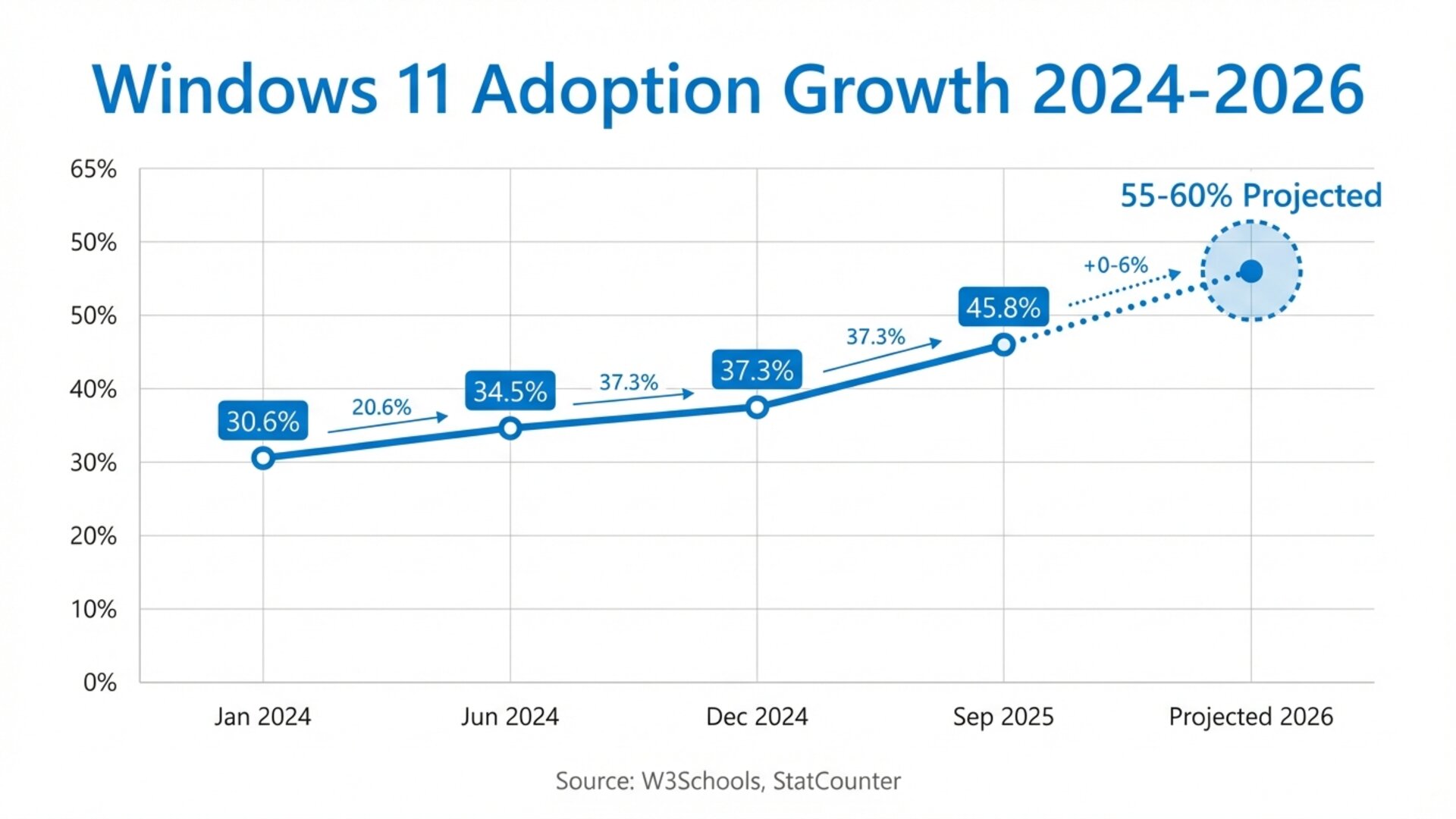
Windows 11 adoption has followed a slower trajectory than Microsoft would have expected. Analyzing the historical evolution according to W3Schools data, we can observe the following growth:
- January 2024: Windows 11 represented 30.6% of the market
- June 2024: The share rose to 34.5%
- December 2024: Windows 11 reached 37.3%
- September 2025: The share reached 45.8%
This growth represents an increase of approximately 15 percentage points in less than two years, indicating an acceleration in adoption. However, the pace remains insufficient for Windows 11 to become the predominant version before the end of Windows 10 support scheduled for October 2025.
Factors driving Windows 11 adoption include:
- Hardware renewal: Users who purchase new computers receive Windows 11 pre-installed
- Security features: TPM 2.0 and Secure Boot offer enhanced protection
- Productivity improvements: Snap Layouts, improved virtual desktops, and widgets
- AI integration: Copilot and other artificial intelligence features
- Windows 10 end of support: The approaching end of life cycle drives migrations
Windows 10 End of Support: Implications for Millions of Users
Microsoft has confirmed that extended support for Windows 10 will end on October 14, 2025. This date represents a critical milestone for the hundreds of millions of devices still running this version of the operating system. According to estimates based on current market data, approximately 800 million devices still use Windows 10 worldwide.
The end of support means Microsoft will stop providing:
- Free security updates
- Patches for critical vulnerabilities
- Official technical support
- Feature updates
For users and businesses who wish to continue receiving security updates after October 2025, Microsoft offers the Extended Security Updates (ESU) program, although this service has a significant additional cost. The most recommended alternative is to upgrade to Windows 11, which requires verifying that the hardware meets the minimum system requirements.
If your computer meets Windows 11 requirements but you haven't upgraded yet, you can get a Windows 11 Pro license at an affordable price and enjoy all the security and productivity improvements the new operating system offers.
Windows Statistics in the Gaming Sector
The video game sector offers a different perspective on operating system adoption, as gamers tend to maintain more up-to-date hardware. According to the Steam Hardware Survey, the world's largest video game distribution platform, data from February 2026 shows:
- Windows (total): 94.62% of all Steam users
- Windows 11 64-bit: 66.71% of users
- Windows 10 64-bit: 27.79% of users
- Windows 7 64-bit: 0.08% of users
- macOS: 2.01% of users
- Linux: 3.38% of users
These data reveal that in the gaming segment, Windows 11 has already far surpassed Windows 10, with a difference of almost 40 percentage points. This discrepancy with general market data is explained by several factors:
- Gamers tend to renew their hardware more frequently
- Modern game requirements incentivize system upgrades
- DirectX 12 Ultimate performance improvements on Windows 11
- Compatibility with technologies like Auto HDR and DirectStorage
It's also notable that Linux has gained ground in the gaming sector, reaching 3.38% of the Steam market. This growth is largely due to the success of Steam Deck and improvements in the Proton compatibility layer.
Windows in the Enterprise Market
The enterprise sector presents different dynamics compared to the consumer market. Organizations tend to be more conservative in their upgrade decisions due to compatibility considerations, migration costs, and staff training requirements.
According to industry analyst estimates, the distribution of Windows in enterprise environments in 2026 approximates:
- Windows 10 Enterprise: Approximately 65% of corporate devices
- Windows 11 Enterprise: Approximately 30% of corporate devices
- Windows Server: Present in more than 70% of enterprise data centers
- Previous versions: Approximately 5% (including Windows 7 on legacy systems)
Companies face significant pressure to migrate to Windows 11 before Windows 10's end of support. However, many organizations have opted for gradual migration plans that will extend into 2026 and even 2027, taking advantage of Extended Security Updates options to gain additional time.
Main challenges for enterprise migration include:
- Compatibility of critical legacy applications
- Unmet hardware requirements in aging device fleets
- Hardware and license upgrade costs
- Need for exhaustive testing before deployment
- End-user training on the new interface
Regional Trends in Windows Usage
Windows usage varies considerably by geographic region. Analyzing available data, we can identify the following trends:
Europe
Europe has one of the highest macOS shares, with approximately 18-20% of the market in countries like the United Kingdom, Germany, and France. However, Windows remains dominant with around 68-70% of the market. Windows 11 adoption in Europe is slightly above the global average, driven by privacy regulations that favor security updates.
North America
The United States and Canada show patterns similar to Europe, with a strong macOS presence in the creative and educational sectors. Windows share stands at around 65-70%, with Windows 11 adoption close to 40%.
Asia-Pacific
This region has the highest Windows share globally, exceeding 80% in many countries. China, in particular, maintains a significant dependence on Windows, although with a notable presence of older versions like Windows 7 due to legacy software. Japan and South Korea show Windows 11 adoption rates above average.
Latin America
Windows dominates the Latin American market with shares exceeding 85% in most countries. Windows 11 adoption is below the global average due to longer hardware renewal cycles and economic constraints.
Africa and Middle East
These regions show the highest dependence on older Windows versions, with significant percentages of Windows 7 and Windows 8 still in use. Total Windows share exceeds 80%, but the transition to Windows 11 is the slowest globally.
Projections for 2026-2027
Based on current trends and market factors, we can project the following scenarios for the Windows ecosystem:
Projection for late 2026
- Windows 11 could reach 55-60% of the Windows market
- Windows 10 would decline to 35-40%
- Legacy versions (Windows 7, 8) would remain around 3-5%
Factors that will influence these projections
- Windows 10 end of support: Will significantly accelerate migrations
- Windows 12 launch: Rumors suggest a possible launch in 2025-2026
- Enterprise hardware renewal: Many companies will take advantage of upgrade cycles
- AI integration: Copilot capabilities will incentivize Windows 11 adoption
- Software requirements: More applications will begin requiring Windows 11
Hardware Requirements for Windows 11
One of the main obstacles to Windows 11 adoption is its stricter hardware requirements compared to Windows 10. The official minimum requirements include:
- Processor: 1 GHz or faster with 2 or more cores on a compatible 64-bit processor or System on a Chip (SoC)
- RAM: 4 GB minimum
- Storage: 64 GB or larger
- System firmware: UEFI, Secure Boot capable
- TPM: Trusted Platform Module (TPM) version 2.0
- Graphics card: Compatible with DirectX 12 or later with WDDM 2.0 driver
- Display: High definition (720p) display greater than 9 inches diagonally
The TPM 2.0 requirement has been particularly controversial, as it excludes a large number of perfectly functional computers manufactured before 2017-2018. Microsoft has maintained these requirements citing security reasons, although unofficial methods exist to install Windows 11 on incompatible hardware.
Frequently Asked Questions
What is the most used version of Windows in 2026?
Globally, Windows 10 remains the most used version with approximately 59.57% of all Windows devices. However, Windows 11 is gaining ground rapidly and is expected to surpass Windows 10 during 2026.
What percentage of the market does Windows have compared to Mac?
Windows dominates the desktop market with approximately 72.67% global share, while macOS represents around 15.19%. This difference has remained relatively stable in recent years.
When does support for Windows 10 end?
Microsoft has confirmed that support for Windows 10 will end on October 14, 2025. After this date, free security updates will not be provided, although a paid Extended Security Updates program will be available.
Is it worth upgrading to Windows 11 in 2026?
Yes, especially considering Windows 10's end of support. Windows 11 offers significant improvements in security, performance, and productivity. If your hardware meets the requirements, upgrading is highly recommended.
How many Windows users are there in the world?
It is estimated that there are more than 1.4 billion active devices running Windows worldwide. This figure includes both desktop computers and laptops in home and business environments.
Why is Windows 11 adoption slower than expected?
The main factors include stricter hardware requirements (especially TPM 2.0), resistance to interface changes, compatibility with legacy software, and the fact that Windows 10 still works well for most users.
Conclusion
Windows usage statistics in 2026 reveal an ecosystem in transition. Although Windows 10 remains the predominant version, Windows 11 adoption is accelerating as we approach the end of official support. With over 1.4 billion active devices, Windows maintains its position as the most used desktop operating system in the world.
For users and businesses, the message is clear: planning the migration to Windows 11 should be a priority. Improvements in security, performance, and productivity justify the upgrade, especially considering that support for Windows 10 will end in October 2025.
If you're looking to purchase a Windows 11 license for your personal computer or business, at Licendi we offer original Windows 11 Pro licenses at competitive prices, with immediate activation and technical support included.
Take advantage of our Windows 11 Pro license offers and enjoy the latest improvements in security and productivity. View Windows 11 Pro Licenses
Sources and References
- StatCounter Global Stats - Windows Version Market Share
- Steam Hardware & Software Survey
- W3Schools Browser Statistics
- Microsoft Official Documentation